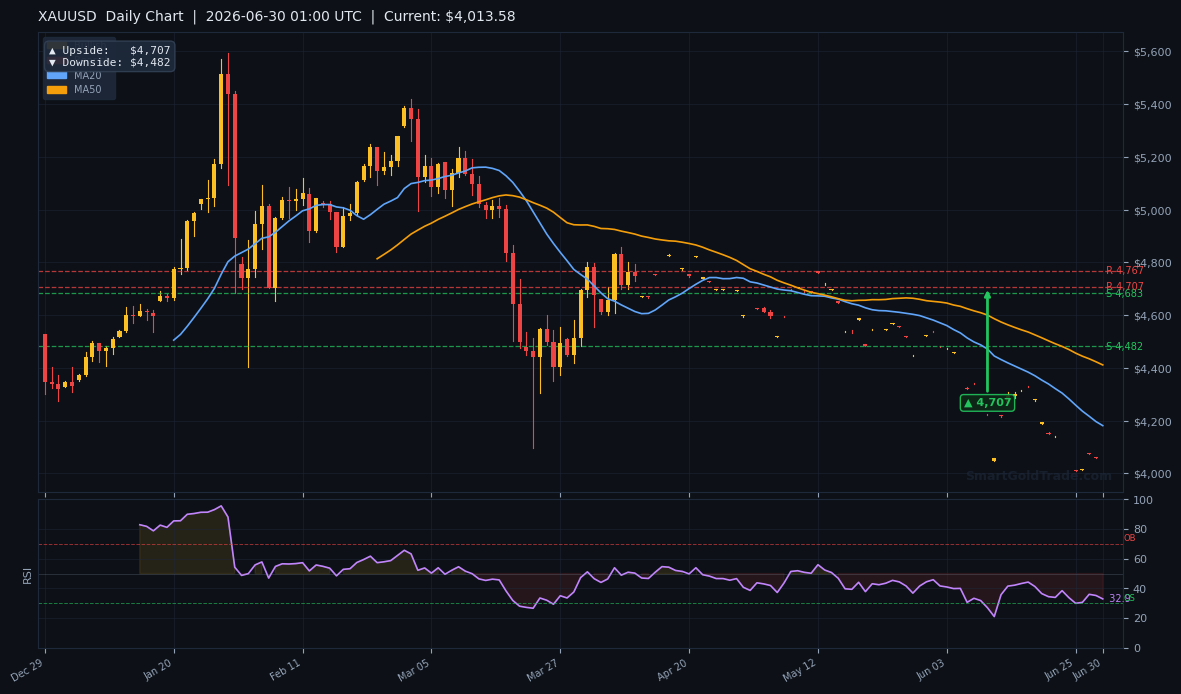
Gold price opened the Asian session at $3,983.20, extending Friday's late sell-off as Monday morning liquidity evaporated. Last week's revised US Q2 GDP print came in softer than expected, yet gold could not attract a bid — a clear signal that sellers have the upper hand. With major hubs in Tokyo, Singapore and Shanghai winding down for the mid-year break, cross-asset volumes are painfully thin. GBP/USD inched lower to 1.3200 after a bullish gap, reflecting the same cautious mood. The message for gold traders this morning is simple: do not chase moves in low volume. Wait for confirmed levels before committing capital, because whipsaws in this environment can shred accounts in minutes.
Gold Price Overview
Macro Context
The US Dollar Index hovers near 102.50, barely moved by the lacklustre currency flows out of Asia. US 10‑year Treasury yields remain elevated at 4.65%, a key anchor dragging on non‑yielding gold and keeping the gold price under heavy pressure. Fed funds futures price a 68% chance of a rate hold in September, and last week's hawkish FOMC minutes reinforced the higher‑for‑longer narrative. Geopolitically, simmering tensions in the Taiwan Strait provide a theoretical bid, but not enough to offset the macro headwinds. Gold price's failure to rally on softer GDP data underlines the depth of bearish conviction right now. Market positioning shows speculative shorts have piled on, reflecting a broad consensus that the gold price could test lower levels before any sustained bounce.
Session Outlook
The Asian session is notorious for vacuum‑like conditions that invite false breaks and sudden reversals. Real‑money flows are absent, leaving algorithmic traders to push gold price around on light volume. Expect gold price to range between $3,970 and $4,010 for the next few hours. Any intraday pop toward the 20‑period moving average near $4,033 will likely attract fresh sellers. The real directional move will materialise when London opens, as institutional desks and corporate hedges hit the tape. Until then, patience is the only edge. Scale down position sizes and focus on preparation, not execution. Remember, gold price in holiday-thinned markets can get erratic — what looks like a breakout may simply be a liquidity vacuum.
Technical Analysis
The 4‑hour chart snapshot at the start of the session showed XAU/USD at $4,013.27, but the subsequent drift to $3,983 has only intensified the bearish gold price structure. All primary moving averages slope lower, and the break of key support zones reframes every bounce as a shorting opportunity. Below we break down the indicator picture, using the exact values computed from live chart data.
Moving Average Structure
The MA20 sits at $4,033.14, the MA50 at $4,107.29 and the MA200 at $4,346.41. Gold price trades below all three, with the 20‑day average crossing beneath the 50‑day, confirming a short‑term bearish pressure pocket. The 200‑day at $4,346 acts as a ceiling on any recovery attempt for weeks to come. For now, even a reclaim of the MA20 would be a meaningful short‑squeeze signal, but that looks unlikely before London.
RSI and Momentum
The 14‑period RSI reads 39.7, technically neutral but biased toward oversold territory. In the current down‑move, an RSI dip below 35 would not be surprising, although a defence of the 30 level could trigger a mechanical bounce. There is no bullish divergence yet, so momentum remains with bears. Use RSI extremes as confirmation rather than a standalone trigger — oversold alone is not a buy signal in a gold price downtrend.
Key Price Levels
Support levels S1 at $4,234.79 and S2 at $4,182.58 were cleanly broken in prior sessions and now function as overhead resistance for any gold price recovery. With spot gold price at $3,983, the first demand zone is the psychological $3,980, ahead of the $3,950 handle. The ATR(14) of $16.32 projects a natural daily range of roughly $3,966 to $4,000. On the upside, the 1‑hour pivot target at $4,076 and the 4‑hour target at $4,139 represent levels where sellers are likely to reload.
| Timeframe | Upside Target | Downside Target |
|---|---|---|
| Daily | $4,707 | $4,482 |
| 4-Hour | $4,139 | $4,140 |
| 1-Hour | $4,076 | $4,040 |
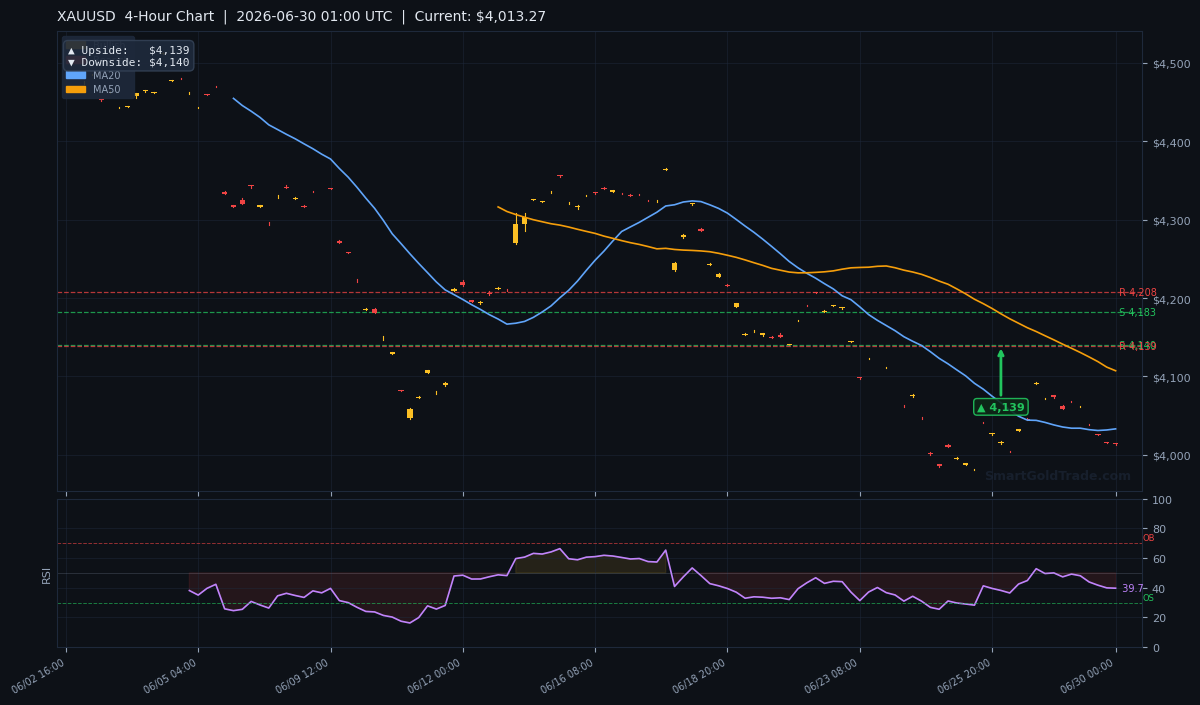
The 4‑hour chart captures the broader structure, with bearish moving averages stacked and gold price gravitating toward the lower boundary of the recent range. The broken S1 level now acts as the line in the sand for any recovery.
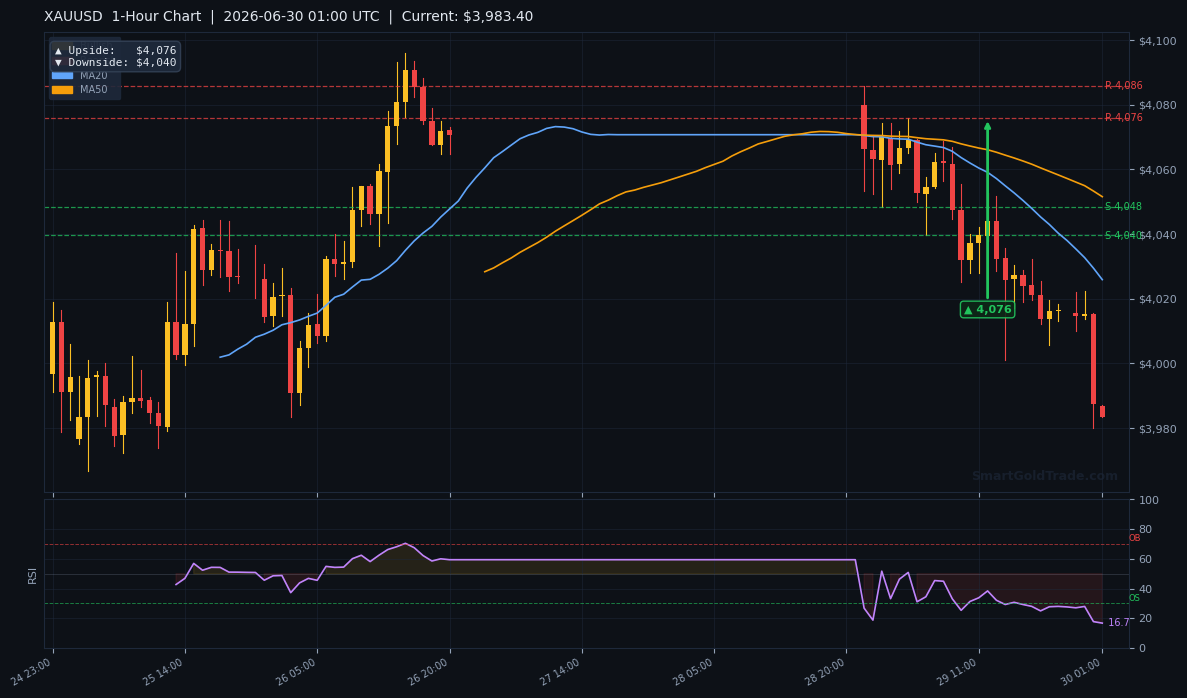
On the 1‑hour time frame, repeated rejections below $4,060 reinforce the intraday gold price downtrend. The $4,040 downside target aligns with the next logical support, and a close beneath it would open a path to $3,980.
Fundamental Drivers
Markets are still digesting last week's US GDP revision, which showed a modest deceleration but not enough to tip the Fed toward early easing. The data calendar is empty during Asian hours, leaving gold price at the mercy of cross‑currents from the dollar and yields. The US 10‑year yield at 4.65% is a persistent weight; gold rarely sustains rallies when real rates are this high. Meanwhile, the British pound's calm after its bullish gap hints that currency markets are in a holding pattern, not driving safe‑haven flows.
Key Event to Watch
The most important risk event this week is Friday's non‑farm payrolls report for June, due on July 3. Consensus expects a 190,000 print, and a number above 220,000 would turbo‑charge the higher‑for‑longer narrative, likely pushing gold price toward $3,920. Conversely, a miss below 150,000 could spark a short‑covering rally back to $4,033. Ahead of NFP, Wednesday's ISM Manufacturing PMI will provide an early temperature check. This economic chain means the current low‑volume drift could persist until mid‑week. Given the gold price's sensitivity to US jobs data, traders should also watch Thursday's ADP private payrolls as a warm-up.
Devil's Advocate
The bearish view on gold price breaks down