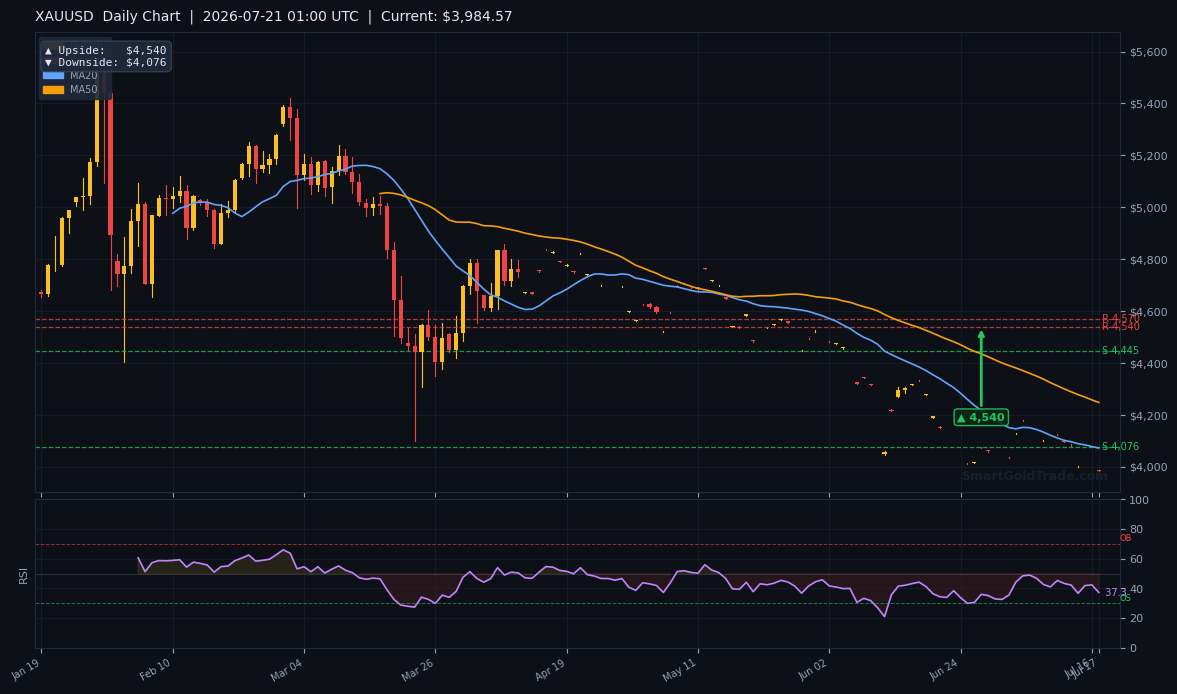
Gold price opened the Asian session at $4,028.72 per troy ounce, trading just above the overnight low but still nursing the wounds of a violent break below the $4,124 support floor. The move came as a wave of de‑risking swept through markets, triggered by renewed Middle East tensions that crushed the Australian dollar and sent ripples across the commodity complex. With liquidity paper‑thin through the Asian hours, the tape is set for jittery two‑way noise, and traders who chase breakouts in these conditions often get stopped out in seconds.
Earlier this week, the $4,124 breakdown rewarded sellers who followed a disciplined setup—entry at the broken structure, a $4,003 target, and a stop above $4,147. That move has now played out, and the gold price is consolidating in the $4,020–$4,050 band, leaving both bulls and bears cautious. The immediate question is whether this is a dead‑cat bounce or the foundation of a deeper recovery.
Gold Price Technical Breakdown: Key Support and Resistance Levels
The four‑hour chart paints a stark picture. The floor that held for weeks at $4,124 was decisively taken out, converting it into a formidable resistance zone. Price action since the break has been sloppy, with repeated rejections near $4,060 suggesting that sellers are reloading at every minor rally. The next support cluster sits near the psychological $4,000 mark, which also lines up with the 61.8% Fibonacci retracement of the May–July upswing.
Volume profile shows a high‑volume node at $3,985, meaning a flush down to that level could attract aggressive dip‑buyers. On the upside, a daily close back above $4,124 would be the first real signal that this breakdown was a fake‑out. Until then, the path of least resistance remains lower, and any long positions should be kept tight with stops under $3,980.
What a Disciplined Entry Looks Like Right Now
The smarter play in this environment is patience. Rather than pre‑empting a reversal, traders who study the gold price are waiting for a confirmed retest of broken structure: a push back toward the $4,124–$4,150 resistance area, followed by a bearish rejection candle on the 4‑hour chart. An ideal short setup would then target the $3,985 demand zone, with a stop just above $4,170. This gives a crisp 1:2 risk‑reward ratio and aligns with the macro‑driven bearish tilt.
For those who want to sharpen their timing with institutional‑grade guidance, professional gold trading signals that map out entry, stop‑loss, and take‑profit levels in real time can eliminate the emotional guesswork. Just remember: even the best signal needs a trader who sticks to the plan.
What’s Moving the Gold Price? Macro and Geopolitical Drivers
Gold’s swift rejection from $4,124 wasn’t a random chart event—it had geopolitical roots. Over the weekend, tensions in the Middle East escalated sharply, prompting a wave of risk‑off positioning that manifested differently across asset classes. While the traditional safe‑haven bid often supports gold, the initial reaction was a scramble for USD cash, which sent the dollar index higher and momentarily trashed gold price correlations.
The Australian dollar, often a proxy for risk appetite, plunged below $0.7000 for the first time in months. Historically, AUD/USD and gold share a positive correlation rooted in Australia’s role as a major gold producer. When the Aussie fell off a cliff, gold was dragged along. This quirk of inter‑market dynamics caught many retail traders off guard, but it’s a pattern that repeats whenever a liquidity crisis forces cross‑asset liquidations.
Bond markets added another layer of complexity. The sharp drop in U.S. 10‑year yields—briefly touching 3.93%—should have buoyed non‑yielding assets like gold. Yet the gold price continued to slide, indicating that the sell‑off was primarily about margin calls and forced de‑leveraging, not a fundamental rejection of gold as a store of value.
Gold as a Safe Haven: Why the Pullback Might Be Temporary
Despite the messy price action, the structural case for holding gold has not evaporated. Central banks around the world continue to accumulate bullion at a record pace, and the BRICS nations are actively exploring gold‑backed settlement mechanisms that could reduce dependency on the U.S. dollar. In an environment where geopolitical shocks are becoming the norm, the long‑term bid under the gold price remains intact.
Veteran traders recognize these flush‑outs as a feature of modern gold markets. The last three times the gold price breached a major support on a geopolitical gap, it reclaimed the level within eight to twelve trading sessions. If the Middle East situation cools even marginally, the same algorithmic strategies that pushed gold lower could pivot on a dime, sparking a sharp short‑covering rally. That doesn’t mean blindly buying here; it means keeping a shopping list of levels where the risk‑reward flips.
Halal Gold Investment: Shariah‑Compliant Ways to Capitalize on Gold Price Moves
Beyond the daily swings that dominate trading screens, many investors see dips like this as opportunities to build long‑term exposure in a manner that aligns with their faith. Conventional gold trading often involves leveraged CFDs, overnight swap fees, and speculative instruments that conflict with Islamic finance principles. At SmartGoldTrade, we’ve built an ecosystem that lets you act on the gold price without compromising your values.
Physical Gold: A Tangible Store of Value
When markets turn chaotic, there’s a deep comfort in holding something real. Whether you’re hedging against currency devaluation or simply preserving wealth, you can purchase physical gold in the form of 22K coins, 24K bars, and certified jewelry—all Shariah‑compliant and physically delivered. In times like these, where the paper gold price is whipsawed by leverage and algorithms, owning metal you can touch severs the link to speculative volatility.
Shariah‑Compliant Spot Trading: No Riba, No Gharar
If you prefer to trade the gold price directly but refuse to engage with interest‑bearing accounts or leveraged contracts, our halal gold trading platform offers riba‑free, spot gold trading with physical ownership. Each trade represents a fractional lot backed by real bullion—no CFDs, no swaps, no overnight charges. The market rarely offers clean pullbacks to key levels; when it does, having a Shariah‑compliant vehicle at your fingertips means you don’t have to sit on your hands.
FAQ
Is trading gold halal according to Islamic finance?
Yes, gold trading is halal when it meets strict Shariah criteria: spot transactions with immediate delivery or transfer of ownership, no interest (riba), no excessive uncertainty (gharar), and no leverage that mimics gambling. The halal gold trading solution at SmartGoldTrade was built from the ground up around these principles, ensuring every trade is fully compliant.
Why did the gold price fall when geopolitical tensions rose?
During the initial shock of a geopolitical event, institutional investors often sell liquid assets like gold to cover margin calls in other markets or to raise cash. This creates a temporary decoupling from gold’s typical safe‑haven behavior. Historically, the gold price recovers these losses once the liquidity crunch subsides and broader safe‑haven flows resume.
How can I invest in gold without using interest‑based accounts?
You can buy physical gold coins and bars outright through our physical gold store, or trade spot gold through the Shariah‑compliant trading platform that eliminates swaps and overnight fees. Both methods give you direct exposure to the gold price while adhering strictly to Islamic finance principles.