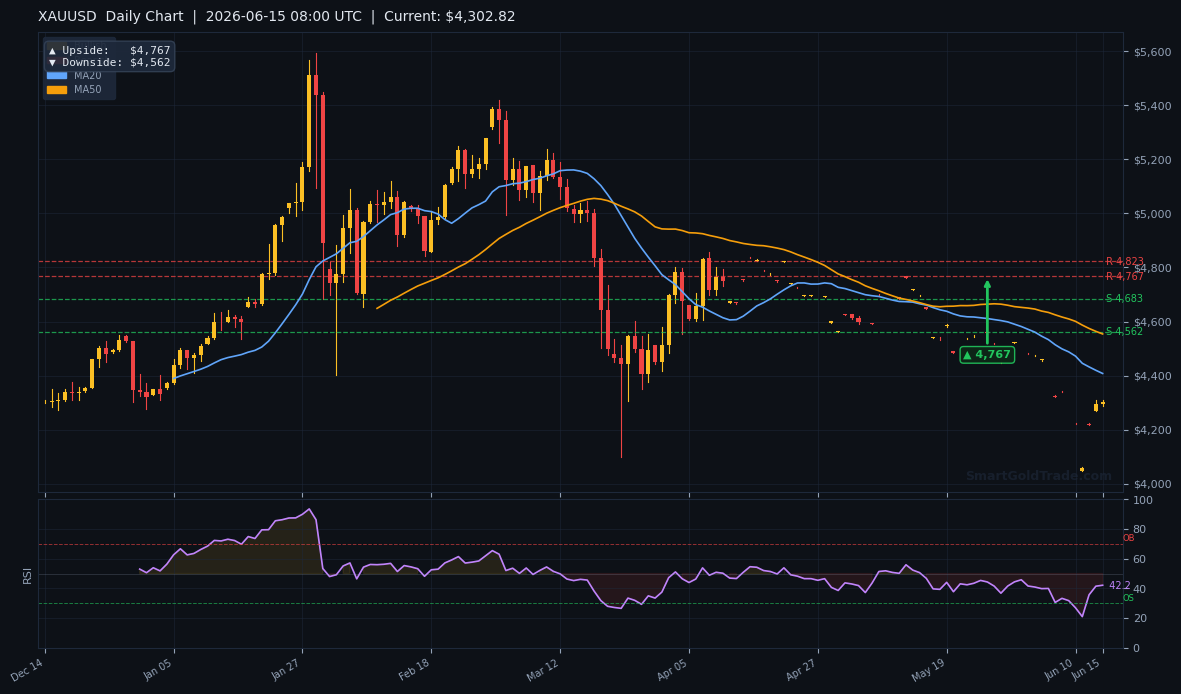
Gold price opens the European session near $4,328.50 with a palpable sense of urgency. The metal is digesting gains from last week’s spike to $4,440, a move fueled by safe‑haven demand after the US struck an Iranian cargo vessel earlier this month. Even as the initial headline shock fades, the unresolved tensions provide an ongoing geopolitical bid. Today, with London desks coming online, volatility is accelerating — the ATR of $30.23 warns that $30 moves could arrive at any moment. Whether this session cracks the stubborn $4,442 ceiling will likely set the tone for the rest of the week.
What’s Driving the Gold Price This Week?
It isn’t just the US-Iran standoff keeping traders glued to their screens. The gold price is being pulled in two directions at once. On one side, elevated geopolitical risk and a softening dollar index are classic tailwinds for bullion. On the other, persistent inflation chatter out of Washington has revived fears that the Federal Reserve could reverse its dovish stance — an outcome that traditionally punishes non-yielding assets. The result is a tug-of-war that makes every tick meaningful.
This ambivalence shows up clearly in the COMEX futures market. Open interest has barely budged over the past three sessions, suggesting that fresh money is hesitant to commit above $4,400. Veteran floor traders are waiting for a confirmed breakout, not a false dawn. As one London-based analyst put it, “No one wants to be the first to buy at the top, but no one wants to miss the ride if we slice through $4,442.”
Technically, the gold price is carving out a textbook bull flag pattern on the four-hour chart. The flagpole extends from the early-June low of $4,079 to the $4,440 spike, while the flag itself is the narrow consolidation between $4,310 and $4,390. A clean break above the upper trendline — and ideally above the $4,442 resistance — would project a measured move toward $4,580. That’s a juicy target, but it requires conviction. Meanwhile, the 50-period simple moving average sits at $4,295, providing a soft floor for any intraday pullback.
Geopolitics: The Unpredictable Engine
The US strike on the Iranian cargo ship has morphed into a slow-burn crisis. Satellite imagery shows two Iranian naval vessels repositioning near the Strait of Hormuz, a chokepoint for roughly 20% of the world’s oil supply. While the market’s initial reaction was a classic risk-off scramble, the absence of immediate retaliation has calmed the panic. However, smart money knows that calm can shatter overnight. That’s why the gold price has built a floor near $4,310 — put simply, no one wants to be short when the next headline drops.
History offers a clear parallel. During the 2020 US-Iran escalation following the Soleimani strike, the gold price rallied $70 in two sessions before giving back half of those gains within a week. In 2025, after drone attacks on Saudi oil infrastructure, the pattern repeated. Traders who engage in halal gold trading often set conditional orders around geopolitical spikes, because the moves are violent but the retracements are predictable. By respecting Shariah rules — no leverage, no swaps, full physical ownership — they can participate without the anxiety of overnight financing costs.
For believers in tangible wealth, the current environment also reinforces the case for physical ownership. The digital screen shows a price, but only a sovereign coin or a certified bar gives you autonomy from the financial system. Platforms that let you purchase physical gold in gram-denominated coins or 24K bars allow you to hedge against both currency debasement and institutional gridlock. It’s a quiet form of insurance that doesn’t appear on a brokerage statement.
Technical Levels Worth Watching
Every trader has a pet level, but three numbers demand respect right now:
- $4,310 — the base of the four-day range. A daily close below this figure would target the 50-day SMA near $4,170, effectively washing out the geopolitical premium.
- $4,442 — the June high. A convincing close above here opens the door to $4,580 and, beyond that, the psychologically magnetic $4,700 level that fast-money algos are already quoting.
- $4,250 — the 100-day SMA. In a risk-off scenario triggered by failed diplomacy, this moving average becomes the line in the sand for longer-term bulls.
Volume profiles on XAU/USD show that the thickest trading node sits between $4,320 and $4,360. As long as the gold price oscillates within that band, breakout traders will feel frustrated. One way to filter out the noise is to enlist professional gold trading signals that strip away the hype and provide data-driven entry and exit points. A rigorous signal service doesn’t guess — it reacts to levels that the market itself has validated.
How Halal Investors Can Navigate the Gold Price
For Muslims who want exposure to the gold price without compromising their faith, the landscape has improved dramatically. Conventional brokers often bundle leverage, swaps, and CFDs — all of which are problematic under Islamic jurisprudence. Shariah-compliant alternatives now exist that offer spot gold trading with full physical allocation. Every gram you trade is backed by allocated metal held in a transparent manner, with no overnight interest charges and no speculative margin that exceeds your equity.
That matters because during high-volatility days, a standard forex account could trigger a margin call just when you need staying power. The ATR reading of $30.23 means a two-minute spike can eat through a tight stop-loss. When you trade on a halal platform, you’re dealing in real ounces, not synthetic contracts. The gold price becomes a straightforward reflection of supply and demand, not a derivative of a derivative.
Investors also have longer-term Shariah products that let you benefit from gold’s secular uptrend without day-to-day noise. Profit-sharing arrangements — such as mudarabah plans — allow you to pool capital with other investors while a qualified manager trades physical gold on your behalf. The returns are distributed quarterly, and the underlying metal is audited to ensure compliance. It’s a far cry from the swap-laden gold ETFs that dominate the Western retail market.
Economic Calendar: The Hidden Catalysts
While geopolitics dominate the headlines, the gold price will face several macro tests this week. Wednesday brings the US Consumer Price Index for May, with economists forecasting a 0.3% month-over-month rise in the core measure. A hotter print could push the dollar higher and momentarily weigh on gold, while a benign reading would give the Fed ammunition to cut rates sooner — a gold-positive scenario. Thursday’s weekly jobless claims and Friday’s University of Michigan sentiment survey will refine the narrative.
Beyond the US, the European Central Bank’s executive board is speaking twice this week. Any hint of a rate divergence between the Fed and the ECB could jolt the euro/dollar pair, which in turn influences the gold price. Gold is priced in dollars, so a weaker dollar generally makes the metal cheaper for holders of other currencies, boosting demand. With the DXY flirting near 102.50, a break below the 102 handle could be the catalyst that sends XAU/USD through the $4,442 ceiling.
Supply-Demand Fundamentals: More Than Just Speculation
It’s easy to forget that behind every chart pattern there’s a physical market. Global gold production in Q1 2026 was 3% lower than the same period a year earlier, with strikes at two major South African mines constraining output. At the same time, central banks — especially the People’s Bank of China and the Reserve Bank of India — continued buying. The PBOC alone added 21 tonnes in April, extending a multi-year diversification away from US Treasuries. This structural demand creates a long-term tailwind for the gold price that speculative short-selling can only dent, not destroy.
Retail demand in India and the Middle East has also picked up, partly because gold loans have become a popular source of collateral in rural economies. When a farmer pledges family gold for a loan, that metal is effectively removed from the market, tightening supply further. These micro-level trends coalesce into a macro-level reality: even if the geopolitical tensions cool, the gold price has a solid foundation.
FAQ
Why is the gold price so volatile right now?
The volatility stems from a mix of unresolved US-Iran tensions, uncertainty about Federal Reserve policy, and the longer-term trend of central bank buying. The average true range of $30.23 reflects a market that is pricing in new information rapidly, making daily swings of $30 or more quite common.
How can I invest in gold without interest or leverage?
You can choose a Shariah-compliant platform that offers spot gold trading with full physical allocation. This means you own the underlying gold outright, with no overnight fees or leverage. Longer-term options like mudarabah profit-sharing plans are also available for those who prefer a managed approach.
What key levels should I watch for a gold price breakout?
Traders are closely watching $4,310 as short-term support and $4,442 as resistance that must be cleared for a sustainable rally. A close above $4,442 would target $4,580 and potentially $4,700, while a breakdown below $4,310 could send prices toward the 50-day SMA near $4,170.