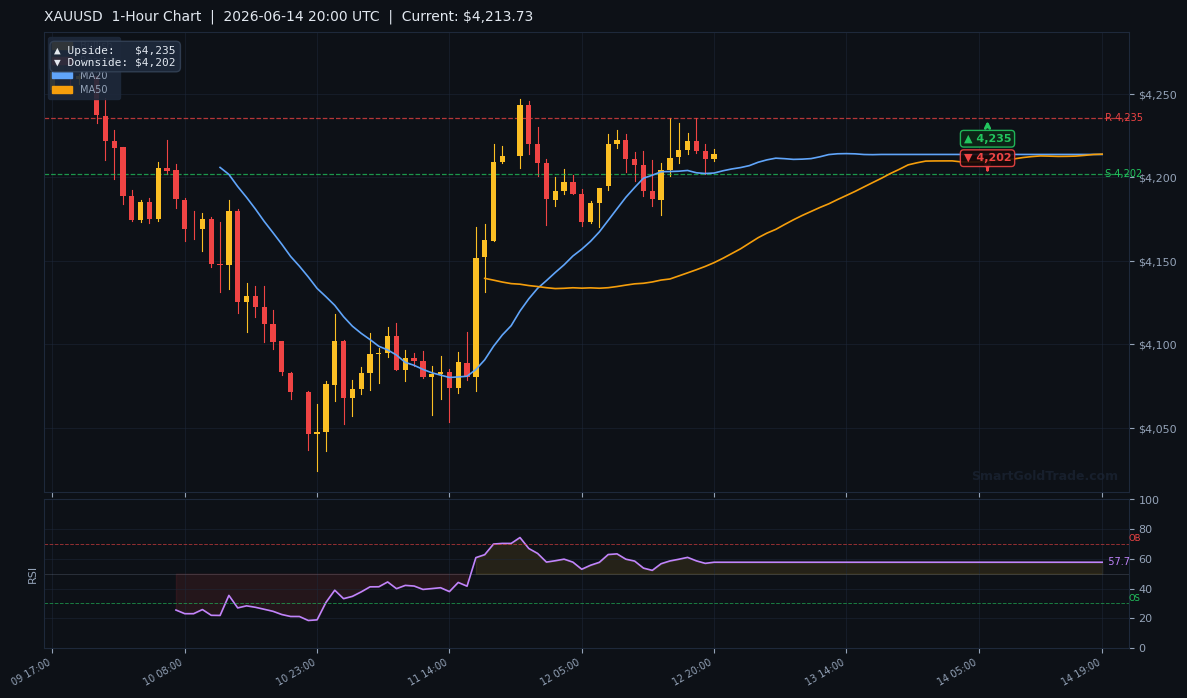
The gold price is trading at $4,287.12 this American session, having vaulted above the $4,235 resistance that capped earlier recovery attempts after last week's Iran-driven spike. The breakout invalidates the prior bearish consolidation and shifts the near-term bias to bullish. Traders are now watching the next upside hurdles at $4,310 (MA50) and $4,471 (4‑hour target), while the former $4,235 barrier flips to immediate support. With the 10‑year US Treasury yield ticking higher and the dollar index firming, headwinds remain, but momentum has decisively turned in favor of the bulls. The volatility compression that had defined the last few hours has resolved to the upside, making the $4,235–$4,200 zone the new floor for the session.
Gold Price Overview and Market Drivers
Macro Context
The US Dollar Index is holding above 105.0, fueled by yesterday's upward revision in the Atlanta Fed's GDPNow model and a steady drip of hawkish rhetoric from regional Fed presidents. The 10‑year Treasury note yield stands around 4.20%, elevating the opportunity cost of holding gold. Rate markets now price less than a 25% probability of a cut at the June 16–17 FOMC meeting, reinforcing a challenging backdrop for the yellow metal. Yet the swift move above $4,235 suggests that technical and safe-haven flows have temporarily overwhelmed the yield headwind.
Geopolitically, last week's US strike on an Iranian cargo vessel jolted gold towards $4,220, but ceasefire overtures have unwound the fear bid. Now, with the gold price surging through $4,235, it appears that any peace deal is being priced in slowly, and the focus has shifted to chart momentum. Still, any negative headline could ignite fresh safe-haven buying and amplify the breakout.
Session Outlook
The American session's earlier range of $4,186–$4,240, based on the ATR(14) of $27.33, has been shattered by the breakout. With spot now above $4,287, the ATR suggests a potential intraday extension toward $4,314. The next psychological test is the $4,310–$4,315 zone, where the 50‑day moving average and round number resistance intersect. A break there would open the door to the 4‑hour upside target of $4,471. On the downside, $4,235 is the first line of defense; a slip below would invite a retest of $4,200.
Traders should remain alert for sudden liquidity vacuums during the New York lunch hour. The thin order books around 12:00–14:00 EST often amplify news-driven spikes. With the FOMC blackout period already suppressing Fed-speak, markets will trade purely on geopolitical and technical flows for the rest of the session.
Gold Price Technical Analysis
Moving Average Structure
The moving averages now paint a more constructive picture. The MA20 at $4,166.75 remains below price, confirming short‑term bullish momentum, while the MA50 at $4,310.42 looms overhead as the next major barrier. The MA200 at $4,513.79 still marks deep bear territory, but the gap has narrowed considerably after today's rally.
The EMA structure — where MA20 < MA50 — flags lingering short‑term bearish pressure despite the bounce from last week's lows. This alignment typically precedes a mean‑reversion move toward the moving average envelope, which currently sits near $4,310. If gold holds above $4,235 and eventually clears the MA50, that bearish alignment will be neutralized, targeting a run toward the $4,513 region.
RSI and Momentum
The 14‑period RSI has climbed to 62.3, exiting the neutral zone and entering mild bullish strength. This reading leaves room for further upside before overbought conditions emerge near 70, aligning with a potential push to $4,310. A dip back below 55 would be needed to question the breakout's validity.
Key Price Levels
The daily pivot framework places resistance at $4,536.14 (R1) and $4,513.84 (R2), while support is seen at $4,473.73 (S1) and $4,442.32 (S2). These longer‑timeframe levels sit well above the current price and will come into focus if the rally accelerates.
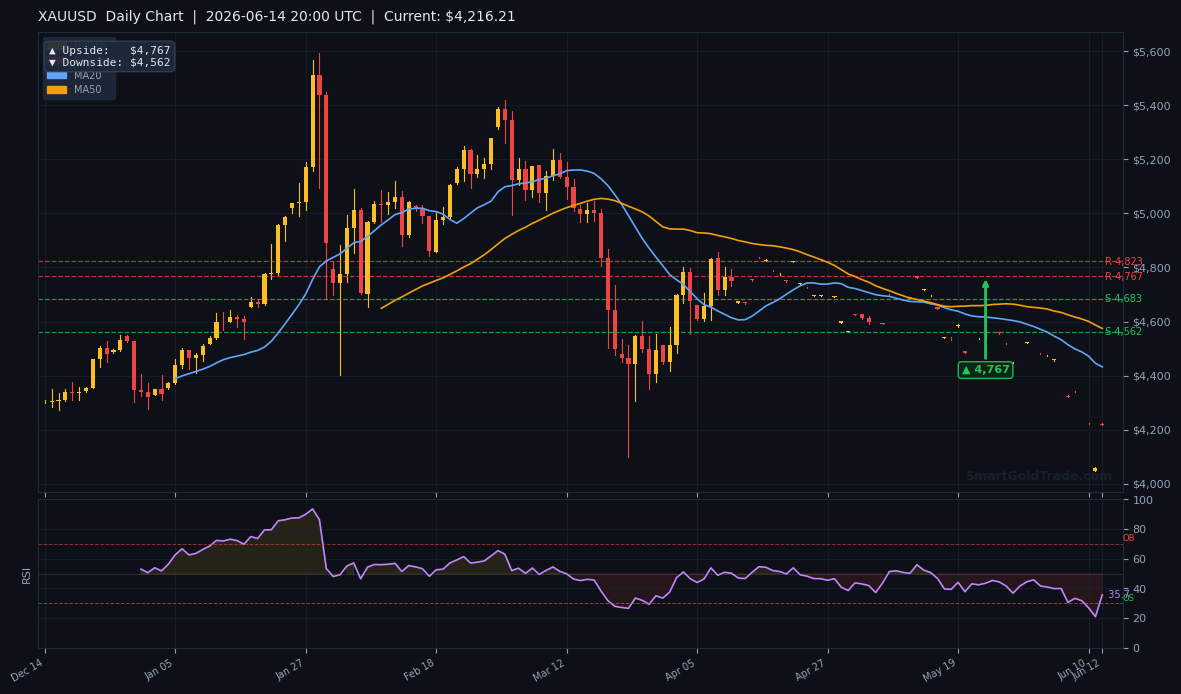
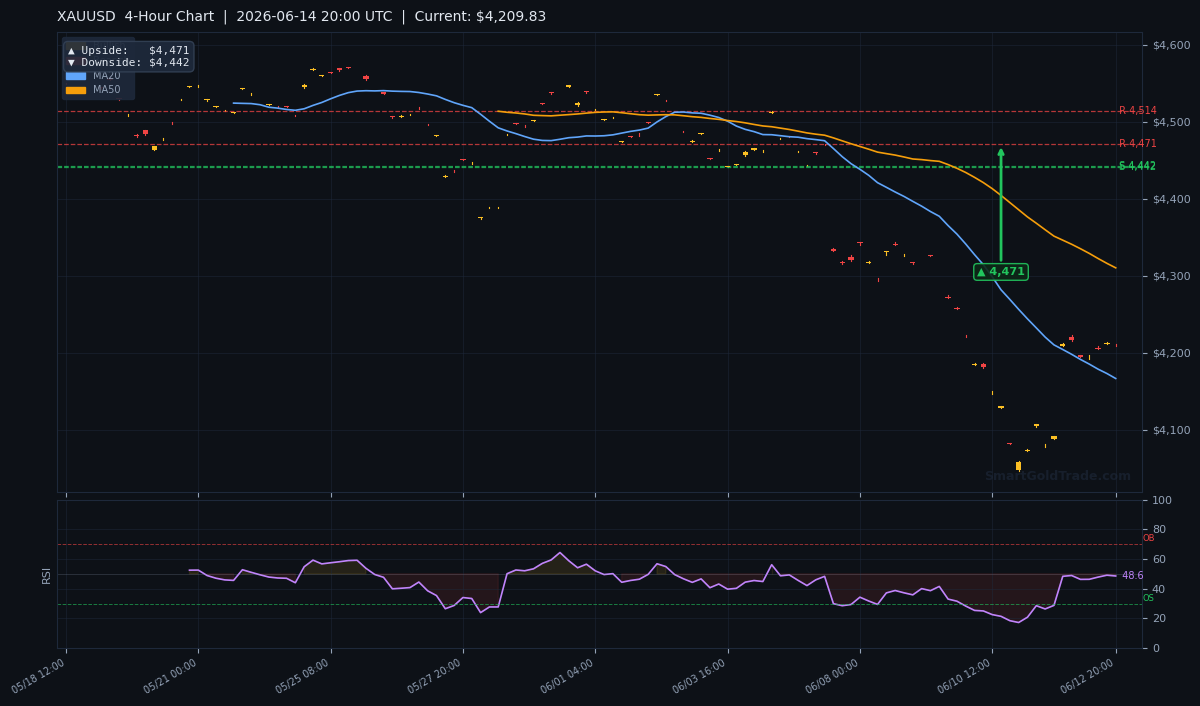
The following table illustrates the multi‑timeframe price targets pulled directly from the pivot arrows on the charts:
| Timeframe | Resistance | Support | Upside Target | Downside Target |
|---|---|---|---|---|
| Daily | $4,536.14 | $4,473.73 | $4,767 | $4,562 |
| 4‑Hour | $4,536.14 | $4,442.32 | $4,471 | $4,442 |
| 1‑Hour | $4,235 (chart) | $4,202 (chart) | $4,235 | $4,202 |
With the gold price breaking above the 1‑hour target, attention shifts to the 4‑hour upside objective at $4,471 and the daily resistance at $4,536.14. The $4,235 level now acts as strong support, aligning with the former resistance-turned-support.
Fundamental Drivers
The overriding macro theme is the US–Iran peace negotiation, which has been sucking the risk premium out of gold. Today's breakout suggests that momentum traders are ignoring the geopolitical lull and focusing purely on technicals. A confirmed peace framework would likely accelerate profit-taking on long positions, but until that happens the path of least resistance remains higher. The correlation with the DXY has tightened to -0.89 over the past 20 sessions, meaning any sudden dollar weakness will disproportionately boost gold.
The market is also digesting last Tuesday's ISM services print, which surprised to the upside and reinforced the “higher for longer” rate narrative. For the gold price to sustain this breakout, either the dollar needs to tumble or a geopolitical shock must override the yield calculus. So far, short-covering and momentum buying have filled the gap, but the rally needs a fresh catalyst to extend beyond $4,310.
Key Event to Watch
The single most important catalyst this week remains the FOMC meeting on June 16–17. Even though the blackout period has begun, the mere anticipation of a hawkish hold caps unlimited upside attempts. If the dot plot or the statement leans even slightly more restrictive, the $4,200 floor will still serve as a critical support if the breakout fails. Traders should monitor Fed funds futures: a 5‑basis‑point increase in the implied December 2026 rate would be enough to trigger a cascade of algorithmic selling. On the flip side, a surprise dovish tilt — unlikely but not impossible given recent consumer credit data — would turbocharge the gold price towards $4,471 and beyond.
Devil’s Advocate
The bearish thesis, which rested on fragile peace talks and Fed hawkishness, has been severely dented by the break above $4,235. Yet devil’s advocates note that a sharp reversal below $4,235 would signal a false breakout, trapping late longs and resuming the downtrend. If peace negotiations produce a concrete deal, safe-haven demand could evaporate quickly, potentially driving gold back toward $4,200. Veteran traders know that the market often punishes consensus — and consensus is now heavily bullish. A bull trap above $4,235 would be just as brutal as the short squeeze that preceded it, making risk management essential.
Trading Strategy After the Breakout
With the gold price breaking above $4,235, the high‑probability setup has shifted to a continuation trade. Aggressive traders can look for a pullback entry on a retest of the $4,235–$4,240 support zone, with a stop loss below $4,218. Initial target is the $4,265 minor resistance, followed by $4,310 (MA50).
The alternative short scenario would only come into play on a failed breakout. A daily close below $4,235 would re-activate bearish pressure, targeting $4,200 and $4,173. For now, that remains a low‑probability event, but it must be respected given the FOMC risk.
For traders who want to avoid riba, our halal gold trading platform offers spot gold ownership without leverage. Those seeking precise entry points can follow professional gold trading signals from InvestorTipster. And for long-term wealth preservation, consider purchasing physical gold coins and bars as a Shariah‑compliant hedge.
Key Takeaways
- The gold price surged to $4,287.12, breaking above the $4,235 resistance and invalidating the near-term bearish bias.
- The breakout opens a path toward $4,310 (MA50) and the 4‑hour upside target of $4,471, with immediate support at $4,235.
- RSI at 62.3 and price above all short‑term moving averages signal bullish momentum, though the MA50 must still be reclaimed.
- The imminent FOMC meeting (June 16‑17) and US‑Iran peace headlines remain wild cards that could spark sharp reversals.
- A failure to hold above $4,235 would revive the bearish scenario and target $4,200 and $4,173.
- The intraday ATR of $27.33 now points to a high‑end range of $4,260–$4,315, urging caution on chasing breakouts without pullbacks.
Conclusion
The gold price has decisively broken free of its recent consolidation, rewarding bulls and punishing shorts. With the Federal Reserve meeting on the horizon and geopolitical uncertainties lingering, volatility will remain elevated. A sustained move above $4,310 would confirm a larger bullish reversal, while a slip back under $4,235 would reintroduce downside risks. For Shariah‑compliant traders, this environment underscores the value of owning physical gold and trading spot without interest, aligning both faith and financial strategy.
FAQ
What factors influence the gold price today?
The gold price fluctuates based on US dollar strength, real yields, geopolitical events, and central bank policy expectations. Today's breakout above $4,235 was driven by short‑covering and technical momentum, despite a firm dollar and hawkish Fed outlook.
How can I invest in gold while staying Shariah‑compliant?
Islamic investors can buy physical gold coins and bars, trade spot gold without leverage (riba) on a halal platform, or participate in profit‑sharing investment pools like musharakah or mudarabah plans. All these methods avoid interest and excessive uncertainty (gharar).
Why is the gold price important for halal traders?
Gold is considered a permissible (halal) asset class in Islamic finance because it is a tangible store of value. Monitoring the gold price helps halal traders time entry and exit points for spot trading and assess the value of their physical holdings, ensuring they maximize returns within Shariah guidelines.