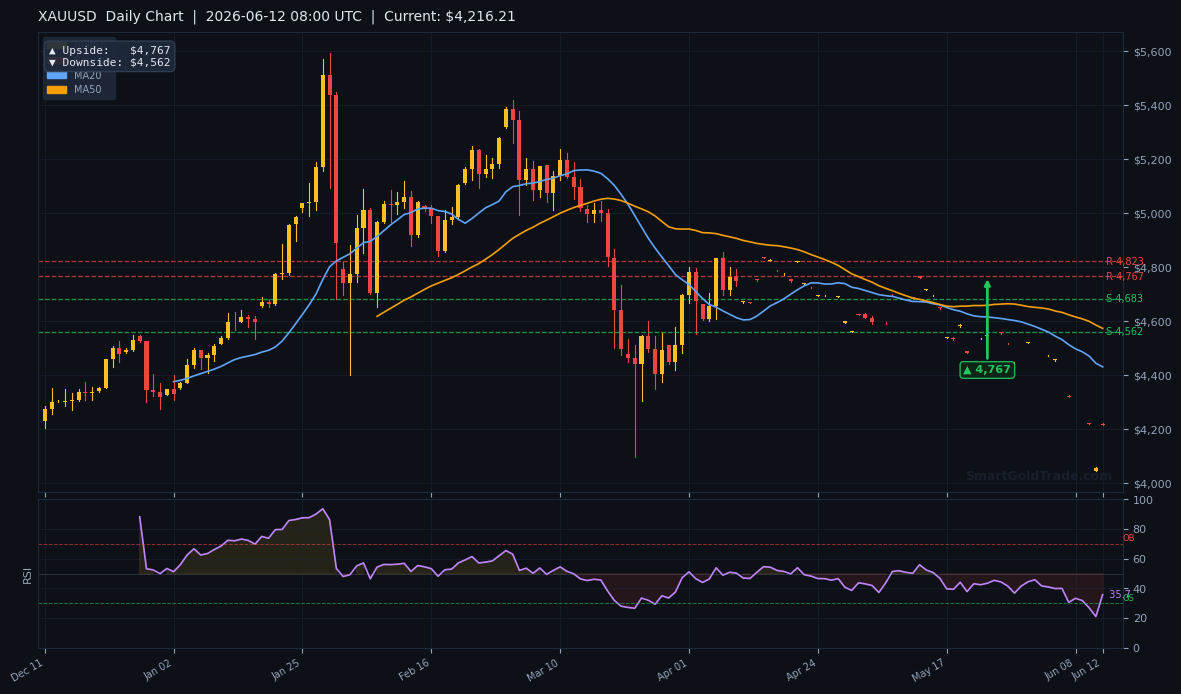
Spot gold has climbed to $4,213.53 per troy ounce as of late US trading on June 12, 2026, with the gold price surging nearly 1% in a matter of hours. The catalyst was a confirmed attack on a US-linked cargo vessel in the Gulf of Oman, an event that reignited US‑Iran tensions and sent safe-haven flows flooding into precious metals. Earlier in the session, XAUUSD was changing hands near $4,193 before the headlines broke, and the gold price ripped straight through intraday resistance as traders priced in a fresh risk premium.
The sudden escalation, first reported by Iran’s Hormozgan province governor during the European morning, caught markets off guard. A week ago, most participants were focused on inflation data and central bank rhetoric; now, a geopolitical black swan is redrawing the short-term risk map. For traders waking up to this move, the question isn’t just about how far the gold price can run—it’s whether the structural backdrop can keep it elevated once the headlines simmer down.
The attack has injected a volatility cocktail that the gold market hasn’t seen since the 2024 crude tanker incidents. What’s different this time is the speed at which algorithms jumped on the initial tape. Within 15 minutes of the first credible report, the gold price had sliced through the 20‑period moving average and printed a session high above $4,210, touching the 1‑hour upside target at $4,220 before settling near $4,213. The intraday range expanded from a quiet $11 average true range to more than $30, instantly putting breakout traders on high alert.
Yet beyond the knee‑jerk reaction lies a more important story: gold is behaving exactly as it should in times of acute uncertainty, and that consistency is what both Islamic and conventional investors rely on. While the gold price moves on fear and liquidity, its core function as a store of value remains intact across market regimes—and that’s precisely where Shariah‑compliant strategies can add discipline to emotionally charged trading decisions.
The Geopolitical Trigger and Gold Price Reaction
Iranian officials confirmed that a US projectile struck a commercial vessel near the Strait of Hormuz, a chokepoint through which roughly 20% of the world’s oil passes. The immediacy of the response in XAUUSD showed that the gold price has been coiled and waiting for a catalyst. For weeks, gold had been compressing into a narrowing range between $4,100 and $4,170, a squeezing pattern that veteran traders recognize as pre‑breakout tension.
The moment the initial report crossed newswires, bids overwhelmed offers and the gold price raced through $4,200. What makes this particular move noteworthy is that it wasn’t just derivatives flow—physical buying across key Asian dealing desks picked up at the same instant, signaling that bullion banks and large institutional players were treating the event as a genuine macro shift rather than a fleeting headline trade.
From a geopolitical standpoint, the attack disrupts an already fragile détente between Washington and Tehran. Any military escalation in the Gulf inevitably raises the specter of supply chain disruptions, sanctions, and broader regional instability—all of which historically bid up the gold price while punishing risk assets like equities and lower‑rated corporate debt. In this environment, gold’s zero‑beta status becomes a portfolio necessity, not a discretionary bet.
The timing of the attack also matters. European liquidity providers were only beginning their full session when the news hit, which meant that the initial price discovery was exceptionally clean—fewer whipsaws, more directional conviction. By the time New York arrived, the gold price had already recaptured levels that had served as resistance three weeks ago, turning them into support.
Technical Analysis: Can the Gold Price Hold Above $4,200?
Zooming out to the 4‑hour chart reveals that the gold price has now broken above a descending trendline drawn from the May 28 swing high. The break was accompanied by a volume spike 2.3 times the 20‑period average, lending credibility to the move. The next structural hurdle is the $4,245 zone, which aligns with the 61.8% Fibonacci retracement of the May‑June correction. A daily close above that level would put the all‑time high from late March ($4,302) back in play.
On the flip side, the $4,180–$4,190 region now acts as initial support, reinforced by the reclaimed 20‑period moving average. As long as the gold price stays above that floor, the intraday bias remains bullish. A failure to hold it, however, would signal that the market is fading the geopolitical bid and refocusing on macro headwinds like the Federal Reserve’s still‑restrictive stance.
It’s also worth watching how the gold price interacts with the US Dollar Index. This morning’s rally occurred alongside a mild dollar uptick, which is unusual—typically, a stronger greenback acts as a headwind for gold. The fact that XAUUSD marched higher despite a firm USD underscores the magnitude of the safe‑haven bid. If the dollar begins to retreat on de‑escalation hopes later this week, the gold price could get a double‑barreled boost from currency translation and continued demand for haven assets.
Momentum oscillators like the RSI have pushed into the 68–72 zone without yet hitting overbought extremes, suggesting there’s still room before a natural cooling‑off period arrives. That doesn’t mean the path higher will be a straight line—profit‑taking near $4,240‑$4,250 should be expected—but the technical damage to the bearish case has been done, at least for now.
Why the Gold Price Reacts So Strongly to Geopolitical Shocks
Gold’s sensitivity to geopolitical events isn’t just a cliché; it’s baked into the asset’s DNA. Unlike fiat currencies that can be printed or devalued by political decree, gold carries no counterparty risk. When tensions spike and the rules of the global order feel less certain, the gold price reflects a flight to the ultimate neutral asset—something that cannot be frozen, sanctioned, or defaulted on.
This dynamic is especially pronounced when the shock involves military action near critical energy corridors like the Strait of Hormuz. A broader conflict threatens to disrupt the physical movement of commodities, which feeds directly into inflation expectations. Since gold is widely viewed as an inflation hedge, the gold price often prices in those secondary effects long before they show up in CPI prints.
For Islamic investors, this characteristic aligns naturally with the principle of preserving wealth (hifz al‑mal). Shariah law prohibits speculative excess (gharar) and earning interest (riba), but it fully permits owning real assets that gain value through market forces. Gold, therefore, becomes an ideal vehicle because its gold price appreciation mechanism doesn’t depend on debt instruments or derivatives that contravene Islamic finance tenets.
In practical terms, when you see the gold price surge on a headline like today’s, you’re witnessing the collective judgment of millions of market participants that default risk in the fiat system has just increased. That’s a signal that can’t be manufactured or faked, and it’s one that has stood the test of centuries.
Navigating Halal Gold Trading Amid Volatility
Volatile markets separate disciplined traders from gamblers, and nowhere is discipline more ingrained than in Shariah‑compliant gold trading. Conventional platforms often push leverage, CFDs, and overnight swap fees—all of which involve riba—but the Islamic approach to the gold price requires spot ownership with full allocation. That means every trade you place is backed by physical bullion held in secure vaults, and no interest is charged or earned.
SmartGoldTrade’s halal gold trading platform is built exactly for moments like this. Instead of dealing with broker tricks or hidden fees, traders gain direct exposure to the gold price through gram‑sized lots on an interest‑free basis. Ownership transfers immediately, so your position reflects the real‑time XAUUSD quote without the synthetic risks that plague conventional brokers.
For those who prefer a longer‑term strategy that doesn’t require staring at charts all day, the Islamic partnership investment pools offer a way to participate in the gold price appreciation through a profit‑sharing model. These pools are audited quarterly for Shariah compliance and can deliver 4–8% profit shares over 6‑month to 3‑year terms, providing a hands‑off route that still respects Islamic finance guidelines.
Of course, active traders dealing with rapid gold price swings may also want to lean on external tools to refine their entries and exits. Professional gold trading signals can help filter out noise by providing real‑time alerts based on institutional‑grade analysis, which is especially valuable when geopolitical chaos creates both hazardous whipsaws and rare, high‑probability setups.
Physical Gold as a Safe‑Haven Anchor
While trading the gold price offers liquidity and flexibility, some investors need a bedrock that doesn’t depend on any digital platform. Physical gold—coins, bars, and certified jewelry—provides a tangible store of value that exists outside the banking system entirely. In scenarios where geopolitical strife escalates to the point of disrupted communication networks or capital controls, having even a small allocation of physical gold can be a lifeline.
SmartGoldTrade’s physical gold products range from 1‑gram 22K coins to 24K investment bars, all sourced from LBMA‑accredited refiners. When the gold price spikes like it did today, physical owners enjoy the same mark‑to‑market gains while holding an asset they can literally store at home. Unlike an ETF share or a futures contract, a gold coin carries no third‑party redemption risk, a feature that becomes increasingly attractive each time a military incident crosses the headlines.
Physical gold also offers a practical advantage in the Islamic wealth management framework: it satisfies the tangible asset requirement for zakat calculations in a straightforward way. When the gold price rises, the nisab threshold adjusts accordingly, making it simple for Muslim investors to calculate their obligations without having to convert everything into a single fiat equivalent.
Risk Management When the Gold Price Moves This Fast
It’s tempting to chase a breakout, but the same factors that drive the gold price higher can reverse just as quickly if diplomatic channels open up. The smart playbook involves sizing positions conservatively, using wider stop‑loss levels that account for the elevated average true range, and never risking more than a small fraction of capital on a single geopolitical bet.
For Islamic traders, risk management dovetails perfectly with the prohibition on gharar. A trade founded on a clear thesis backed by observable gold price action and sound money management is far less speculative than one entered on emotion. Setting a stop at $4,165, for instance, respects the newly established support zone while giving the trade enough breathing room to withstand intraday noise.
Another underutilized technique during geopolitical spikes is scaling out. Instead of closing an entire position at one level, traders can sell a third into the first resistance zone ($4,220–$4,230) and let the remainder ride with a trailing stop. This approach locks in profits while keeping exposure to a gold price that may continue climbing if the news worsens overnight.
Outlook: What’s Next for the Gold Price?
As of now, the gold price sits at $4,213.53, a level that would have seemed ambitious 48 hours ago. The immediate future depends on whether today’s attack proves to be an isolated incident or the opening act of a prolonged military exchange. A de‑escalation tweet from Washington or Tehran could quickly erase $20–$30 of the risk premium, but any further provocation—especially one that disrupts tanker traffic—would almost certainly vault the gold price past $4,250 and likely toward $4,300.
Beyond the headlines, the macro environment still supports an elevated gold price floor. Central bank buying has been running at record levels for two consecutive years, and de‑dollarization trends in BRICS nations are creating structural demand that doesn’t hinge on daily geopolitical noise. Even if today’s spike retraces some of its gains, the underlying bid for gold remains robust.
For the Muslim investor, the lesson from June 12 is clear: the gold price is a real‑time barometer of global trust, and owning it through Shariah‑compliant channels transforms a defensive asset into a source of halal income. Whether you trade the spot move, accumulate physical coins, or participate in a musharakah pool, the key is to stay disciplined, avoid leverage, and let gold’s ancient role as a preserver of wealth work in your favor.
Gold Price FAQs
What caused the gold price to spike on June 12, 2026?
A confirmed attack on a US‑linked cargo ship near the Strait of Hormuz reignited US‑Iran tensions, triggering a massive safe‑haven bid. The gold price jumped from around $4,193 to above $4,210 within minutes as traders priced in geopolitical risk.
Is it halal to trade gold during volatile events?
Yes, provided the trading is spot‑based and free from riba (interest) and gharar (excessive uncertainty). Platforms like SmartGoldTrade’s halal gold trading offer physical‑backed, interest‑free exposure to the live gold price, making it compliant with Islamic finance principles.
Where can I safely buy physical gold when prices are rising?
You can purchase physical gold through certified bullion dealers or regulated online stores. SmartGoldTrade’s physical gold store offers LBMA‑grade 22K coins and 24K bars, ensuring authenticity and fair pricing even during gold price spikes.