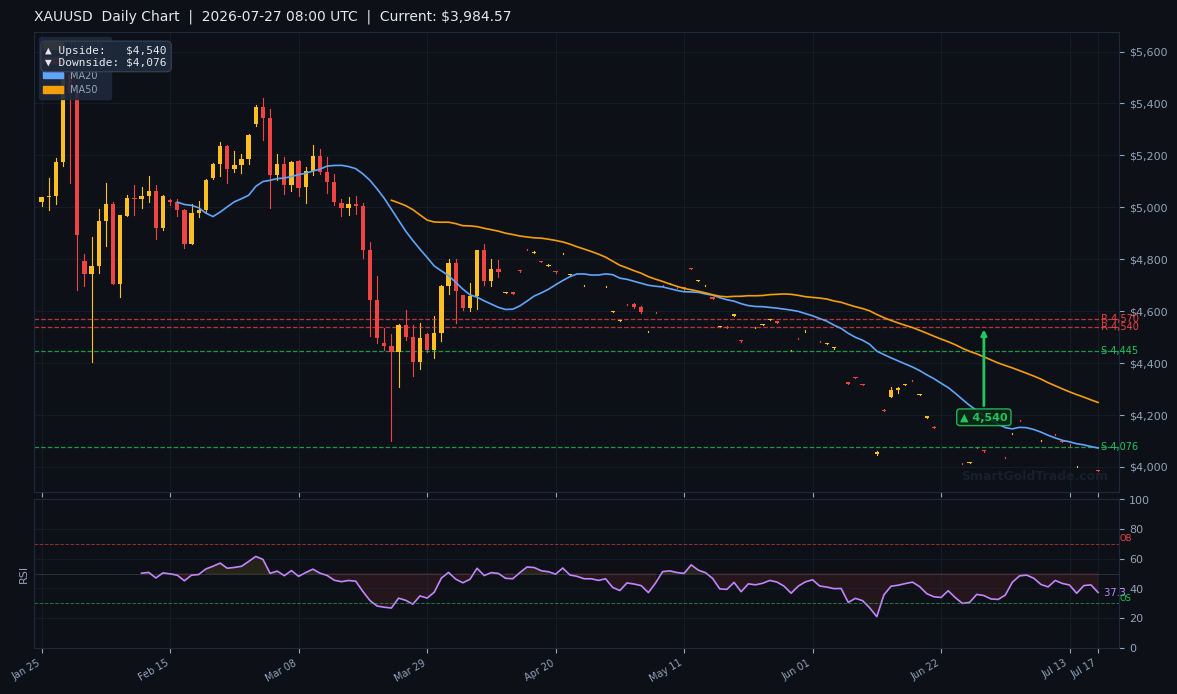
The gold price slipped below the $4,064 mark early Monday, extending losses from the July 25 close of $4,055.52 to trade at $4,013.47 as the European session gets underway. The bearish momentum comes as traders brace for this week’s Federal Reserve decision and a fresh round of Middle East geopolitical uncertainty. A sharp repricing of US interest-rate expectations has already sent the dollar index climbing toward multi-month highs, draining appetite for non-yielding bullion. With the FOMC statement and July Nonfarm Payrolls just days away, the gold price sits dangerously close to a technical tipping point. Whether the metal can defend the $4,000 psychological threshold or breaks toward fresh lows will likely hinge on the tone of Wednesday’s rate guidance.
What’s Pressuring the Gold Price Right Now?
This week’s sell-off isn’t happening in a vacuum. Three powerful forces are converging to push the gold price lower, and none of them show signs of easing until the Fed speaks. First, the US dollar has been on a tear. Since the final days of July, the greenback has appreciated against nearly every major currency, making dollar-denominated gold more expensive for foreign buyers. When the dollar rises, the gold price typically falls—it’s one of the oldest inverse relationships in the commodities market.
Second, real yields on US Treasuries have edged higher as markets price in the possibility that the Fed will keep rates higher for longer. Gold offers no yield, so when investors can earn a risk-free return of 2% or more above inflation from government bonds, the opportunity cost of holding bullion spikes. That’s exactly what’s happening now. Third, risk appetite in equities has been surprisingly resilient. Despite the geopolitical noise, the S&P 500 has held near record levels, diverting capital away from safe havens. As long as stocks look attractive, the gold price will struggle to find aggressive bids.
Fed Decision Looms Large Over the Gold Price
The Federal Open Market Committee meeting this Wednesday is the single most important event for the gold price in the near term. Markets are not expecting a rate hike—the current 5.25%–5.50% range is widely seen as the terminal rate. What matters is the dot plot, the summary of economic projections, and Chair Powell’s language during the press conference. If Powell signals that rate cuts are further away than previously thought, the dollar could extend its rally, and the gold price might retest levels below $4,000 in a hurry.
Historically, gold tends to perform best when the Fed turns dovish. We saw it in 2019 before the pandemic and again during the 2020–2021 stimulus era. Conversely, when the central bank adopts a hawkish posture, the gold price often suffers. Right now, the market is leaning hawkish. Inflation has cooled but remains above the 2% target, and the labor market is still tight. Even a slightly hawkish tilt could be enough to push the gold price through the $4,000 floor. On the other hand, a surprisingly cautious Fed—perhaps citing global risks—would likely ignite a swift gold price rebound.
Geopolitical Uncertainty: Why It’s Not Helping the Gold Price
It feels counterintuitive. The Middle East is simmering, tensions between major powers are rising, and yet the gold price is falling. Usually, geopolitical chaos sends investors scrambling for the safety of bullion. So why isn’t it working this time? The answer lies in the dollar’s double role. During periods of extreme uncertainty, the US dollar itself acts as a safe haven. When turmoil erupts, global capital often flees into Treasuries and the greenback, not just gold. That’s what we’re seeing now—a safety bid that’s bypassing the gold price and boosting the dollar instead.
Another factor is that the current geopolitical headlines, while alarming, have not yet disrupted global oil supplies or financial markets in a sustained way. Without a tangible shock—like a major supply cutoff or a financial freeze—the gold price doesn’t get the same safe-haven boost it would during a full-blown crisis. Seasoned gold traders know this; they’re selling into any knee-jerk spikes. For those who trade actively, staying attuned to these nuances is essential, and professional gold trading signals can help filter the noise from meaningful moves by providing real-time, expert-analyzed entry and exit points.
Technical Levels That Matter for the Gold Price
From a technical perspective, the gold price is flirting with disaster. The $4,000 level is not just a round number—it represents a confluence of support. The 100-day moving average sits near $3,980, and a trendline drawn from the October 2025 lows aligns at roughly $3,960. If the gold price closes decisively below $3,960 on the daily chart, it would open the door to a rapid move toward $3,880, the next major support zone from the March consolidation period.
On the upside, the first resistance is at $4,100, followed by $4,200 where the 50-day moving average and the early July breakdown point coincide. The Relative Strength Index (RSI) on the daily timeframe has dipped below 40, entering bearish territory but not yet oversold. That leaves room for further downside before any meaningful bounce. A daily close above $4,200 would be the first sign that the gold price has stabilized, but until then, the path of least resistance remains lower.
What the Gold Price Drop Means for Shariah-Compliant Investors
While short-term traders might fret over every tick in the gold price, long-term Shariah-compliant investors can view the dip through a different lens. Islamic finance prohibits riba (interest), which eliminates conventional bond-like yields as an investment option. Physical gold, on the other hand, is a tangible asset that fits naturally into a halal portfolio. When the gold price drops to levels like $4,013, it can be an opportunity to accumulate physical bars or coins at a discount. Purchase physical gold through a trusted Shariah-compliant provider ensures you own outright, not a derivative or a promise.
For those who prefer to participate in gold price movements without taking physical delivery, there’s an ethical alternative: halal gold trading. This spot trading model operates without leverage and is structured so you have direct ownership of the underlying gold. No swaps, no overnight interest, no CFD tricks. It’s a transparent way to ride the gold price up or down, perfect for Muslim traders who want to stay true to their faith while navigating volatile markets. And with fractional lots available, even small accounts can participate meaningfully—1 lot equals just 1 troy ounce, a fraction of typical broker requirements.
Whether you’re buying physical to hold for years or actively trading the gold price swings, the current dip could be a strategic entry point. The key is to separate short-term noise from your long-term strategy. If you believe in gold’s role as a store of value in a world burdened by fiat currency expansion and geopolitical risks, then a gold price near $4,000 isn’t a warning sign—it’s a sale.
FAQ
Why is the gold price falling today?
The gold price is under pressure mainly due to a strengthening US dollar and rising real yields ahead of the Federal Reserve’s upcoming policy decision. Strong equity markets have also reduced the immediate demand for safe-haven assets, despite geopolitical tensions.
Is the $4,000 level a good entry point for buying gold?
Historically, round-number levels like $4,000 often act as psychological support. While no one can predict the bottom with certainty, many long-term investors view such dips as opportunities to accumulate physical gold or enter Shariah-compliant trading positions at better prices.
How can I trade the gold price without violating Islamic principles?
You can engage in halal gold trading through platforms that offer spot trading with physical ownership and no interest. These models avoid leverage and swaps, ensuring every transaction is riba-free and compliant with Islamic finance standards.