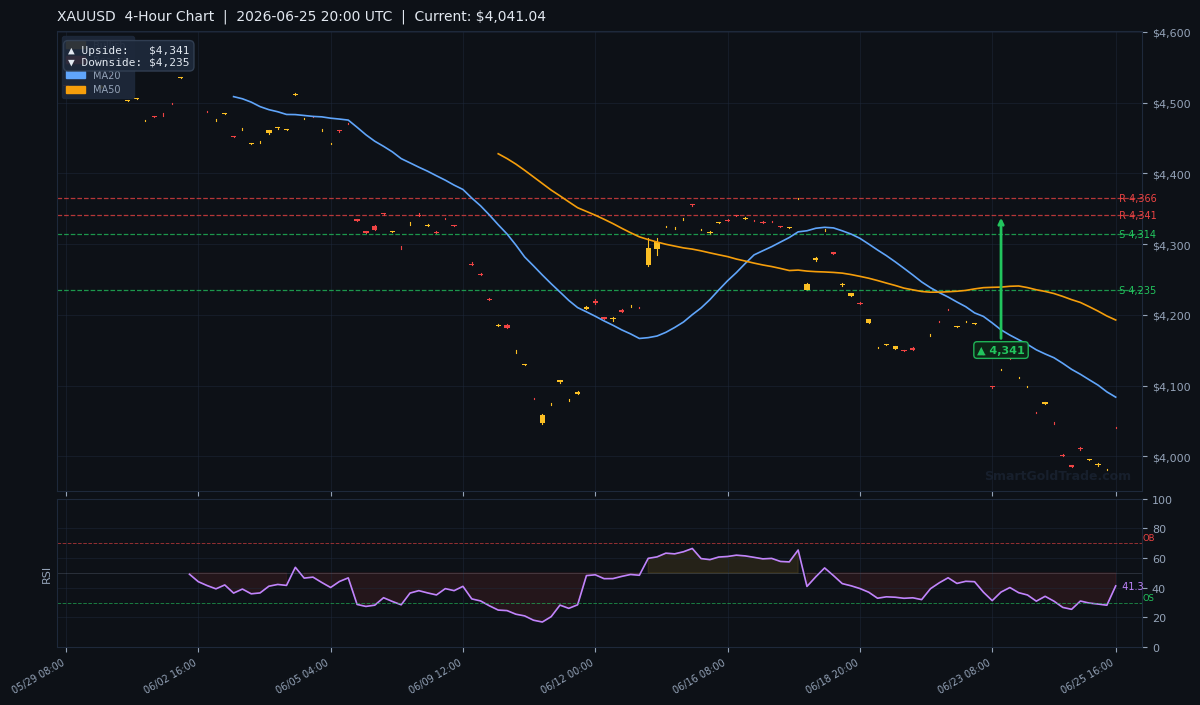
The gold price is locked at $4,041 on the 4‑hour chart this American session, pinned beneath a heavy stack of moving averages after a fresh wave of U.S. dollar strength. A note from MUFG’s Lloyd Chan, pointing to persistent Thai Baht weakness even as oil prices ease, underscores how broad‑based dollar demand is crushing precious metals. With no high‑impact U.S. data on Thursday’s calendar, the path of least resistance remains lower — and the technical landscape already offers a clean short setup with well‑defined risk parameters.
The headline gold price hovers near $4,027, but the XAUUSD chart shows sellers firmly in command. The American session is known for producing the day’s biggest swings, and today’s price action suggests a test of deeper support before the week is out. This article lays out the exact entry, stop, and target levels that align with the bearish structure, so you can act on what the charts are already screaming.
Gold Price Overview: What's Driving the Market Today
Macro Context
The U.S. dollar index is clinging to multi‑week highs, while the 10‑year Treasury yield remains above 4.3%, sapping the appeal of non‑yielding gold. MUFG’s analysis of the Thai Baht — a low‑yielder under a dovish central bank — highlights a global theme: capital is flowing into the dollar as growth differentials widen. That macro backdrop is hostile to gold, especially when the Federal Reserve shows no urgency to cut rates in 2026. This environment keeps the gold price under heavy pressure, with every uptick in real yields translating into lower bids.
Geopolitical noise from Eastern Europe and the Middle East has failed to attract safe‑haven flows, a sign that real yields and relative monetary policy are currently driving the metal. Gold’s correlation with the DXY has tightened to -0.87 over the last 20 sessions, meaning every tick higher in the dollar index saps roughly $8–$12 from XAUUSD.
Session Outlook
Liquidity during the American session should remain healthy through the New York close, but with month‑end flows approaching, range expansion is likely. The absence of a major data release puts the spotlight on technical levels and positioning. If $4,041 fails to attract buyers, the gold price could tumble toward the $4,235 zone. A break above the $4,083 moving average would be the first sign that sellers are losing grip.
Technical Analysis
Moving Average Structure
The 4‑hour chart shows gold price trading below every key average, confirming a bearish alignment. The 20‑period simple moving average sits at $4,083.79, the 50‑period at $4,192.86, and the 200‑period at $4,395.39. With the shorter MAs sloping beneath the longer ones, the structure is textbook bearish — and the fact that gold price has not touched the MA20 in over 36 hours underscores strong selling pressure.
The MA20 itself is now a dynamic resistance; any intraday bounce that fails to close above it would invite fresh shorts. The MA50 at $4,192.86 represents a higher‑timeframe ceiling that isn’t even on the near‑term radar.
RSI and Momentum
The 14‑period Relative Strength Index reads 41.3, sitting firmly in neutral territory but tilting bearish. Values below 50 after a prolonged downtrend typically signal that momentum is aligned with the trend rather than flashing an oversold bounce. With RSI still above 30, there is plenty of room for the sell‑off to continue before exhaustion appears.
Key Price Levels
Immediate support is found at S2 $4,234.79, with S1 $4,313.77 acting as an intermediate floor that has already been tested. On the upside, resistance layers are stacked at R1 $4,365.61 and R2 $4,356.90. The Average True Range over 14 periods is $25.03, suggesting a likely intraday band of $4,016 to $4,066 — a range that comfortably envelopes the current level.
| Timeframe | Upside Target | Downside Target |
|---|---|---|
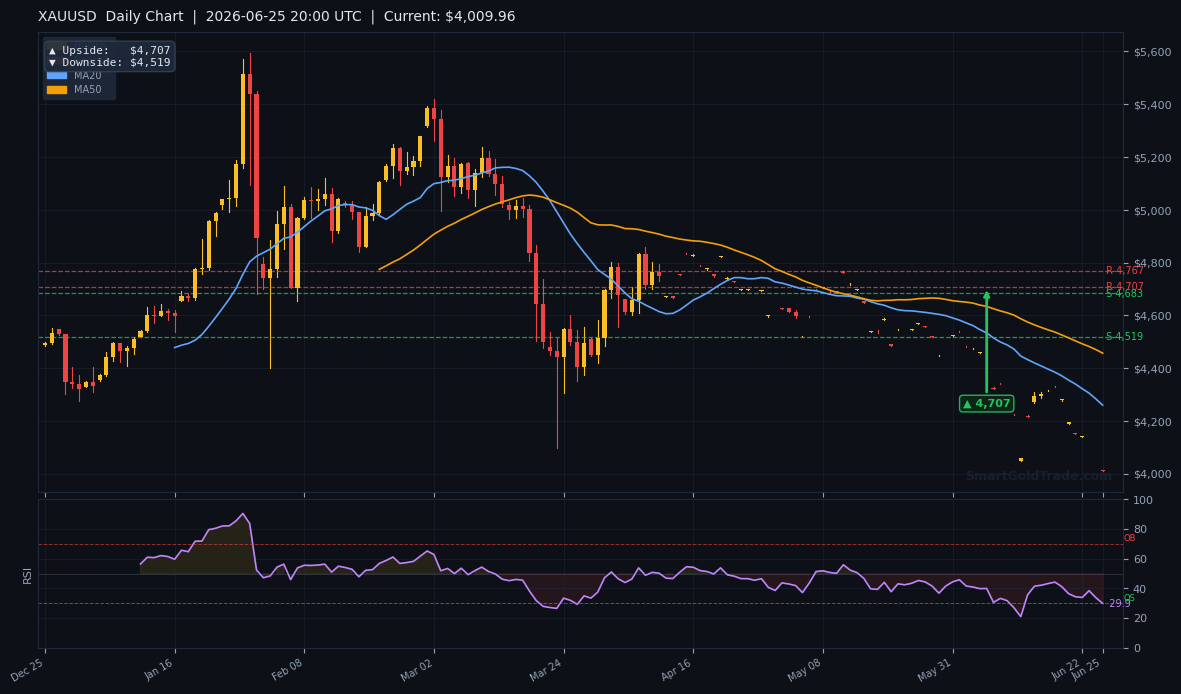
| Daily | $4,707 | $4,519 |
| 4‑Hour | $4,341 | $4,235 |
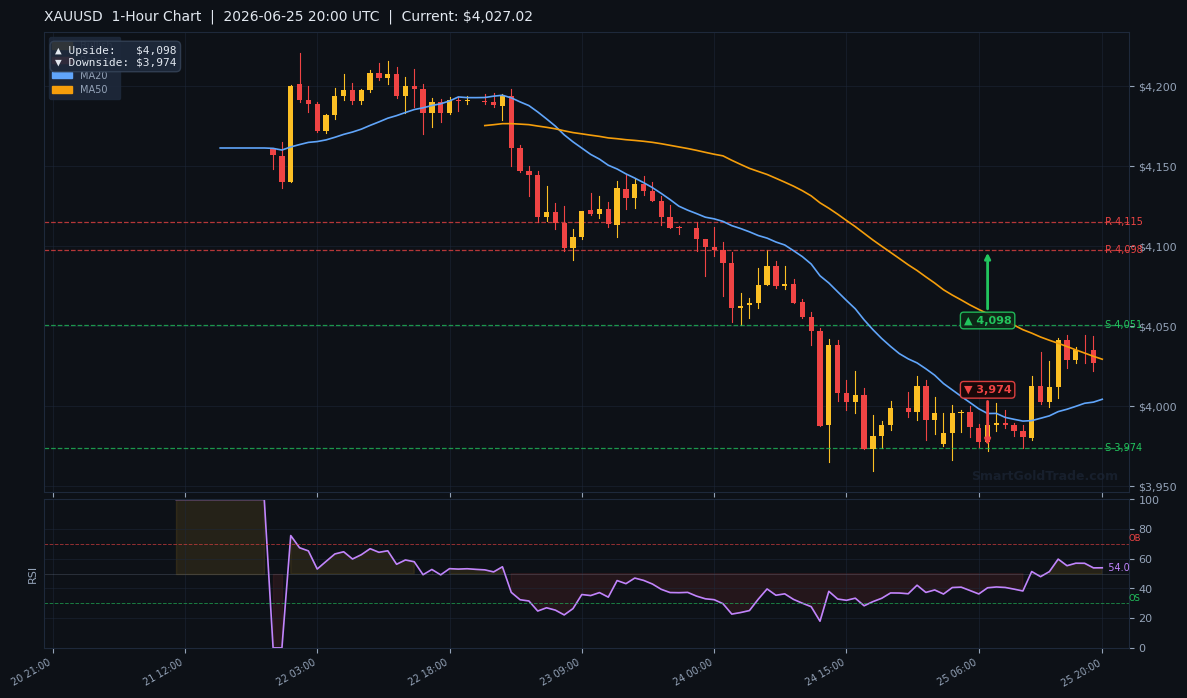
| 1‑Hour | $4,098 | $3,974 |
Fundamental Drivers
The dollar’s relentless grind higher is the single biggest headwind. MUFG’s observation about Thai Baht weakness — persisting even with lower oil prices — reveals that the market is pricing in a widening policy gap between the Fed and Asia‑Pacific central banks. This favors the greenback broadly, which directly pressures the gold price.
Meanwhile, real yields in the U.S. are holding firm, and the probability of a near‑term Fed rate cut has been pushed further out. Gold’s failure to rally on geopolitical tensions suggests that the safe‑haven bid is absent; the metal is behaving purely as a yield‑sensitive asset. Any surprise hawkish commentary from Fed officials this week would only reinforce the downside bias, and the gold price would likely slide toward the S2 support without much hesitation.
Key Event to Watch
The most important release this week is Friday’s U.S. Durable Goods Orders. A stronger‑than‑expected print would amplify dollar demand and likely accelerate gold’s fall toward the $4,235 target. A miss could spark a short‑covering bounce, but as long as price stays below $4,083, the bearish structure holds.
Devil’s Advocate
A daily close above the $4,083 moving average — and, more critically, above the $4,193 level — would flip the short‑term outlook. That scenario could unfold if Durable Goods Orders disappoint badly or if the dollar suddenly retreats on month‑end rebalancing flows. In that case, the gold price could squeeze toward the $4,341 4‑hour upside target, invalidating the current bearish thesis.
If RSI dips below 30 and price holds above $4,234 support, a vicious reversal pattern could trap late shorts. Smart traders will keep a close eye on how price responds around the S2 zone.
Trading Strategy for American Session
The bearish structure calls for a short position near the current market price. Entry is at $4,041, aiming to capture a decline in the gold price to the $4,235 downside pivot. A stop loss placed above the MA20 resistance at $4,083 provides a buffer of $42 — just over one and a half times the daily ATR. This gives the trade room to breathe while respecting the technical invalidation point. The profit target at $4,235 (S2) offers a potential gain of roughly $194 per ounce, yielding a risk‑reward ratio better than 1:4.5 — well above the minimum threshold for a high‑probability swing trade.
Traders who want a more conservative exit can scale out half at $4,280 and let the rest run. For those following Islamic finance principles, you can execute this exact setup on a halal gold trading platform that eliminates riba and leverage, keeping your trades Shariah‑compliant. If you prefer a completely hands‑off approach, copy trading lets you mirror this strategy from a vetted trader, while professional gold trading signals deliver real‑time entry alerts straight to your device.
Key Takeaways
- Gold price is holding at $4,041, below the $4,083 MA20 and all longer averages.
- RSI at 41.3 confirms downside momentum without signaling an oversold bounce.
- The next critical support is S2 $4,235, aligning with the 4‑hour downside target.
- A break above $4,083 — and especially $4,193 — would invalidate the bearish bias.
- Friday’s Durable Goods report is the main catalyst that could accelerate or reverse the sell‑off.
- Risk‑reward on a short from $4,041 to $4,235 stands at over 1:4.5 using a $4,083 stop.
Conclusion
The gold price is trapped in a textbook bearish structure, and the American session offers a clean opportunity to short with defined risk. With the dollar ruling the macro landscape and moving averages casting a long shadow, the path to $4,235 appears open. Look for any bounce that stalls below $4,083 as an opportunity to add to shorts, because the gold price remains in a clear downtrend on the 4‑hour chart. The key invalidation level sits at $4,083; until price reclaims that zone, selling rallies remains the dominant strategy.
Wednesday’s quiet data calendar puts the focus squarely on technicals. Use the levels drawn from the 4‑hour chart, respect the ATR‑based stop, and let the market deliver. As always, manage risk first — and let the trade come to you.
Frequently Asked Questions
- Why is gold price falling despite geopolitical tensions?
- Safe‑haven demand has been overwhelmed by a surging dollar and high real yields. The gold price is currently acting as a yield‑sensitive asset, with the DXY correlation at -0.87. Until the dollar peaks, sell‑offs are likely to persist.
- What is the key support level for XAUUSD this session?
- The most important support is $4,235 (S2), which lines up with the 4‑hour downside target. A daily close below that level would open the door to the $3,974 1‑hour target.
- What would invalidate the bearish short setup?
- A move and close above the $4,083 MA20 — and especially a reclaim of $4,193 — would shift momentum in favor of buyers. The stop loss for the current strategy is placed just above that zone.
Risk Disclaimer: Trading Gold (XAU/USD) carries significant risk of loss and is not suitable for all investors. This content is for informational purposes only and does not constitute financial advice. Always conduct your own research and trade responsibly.