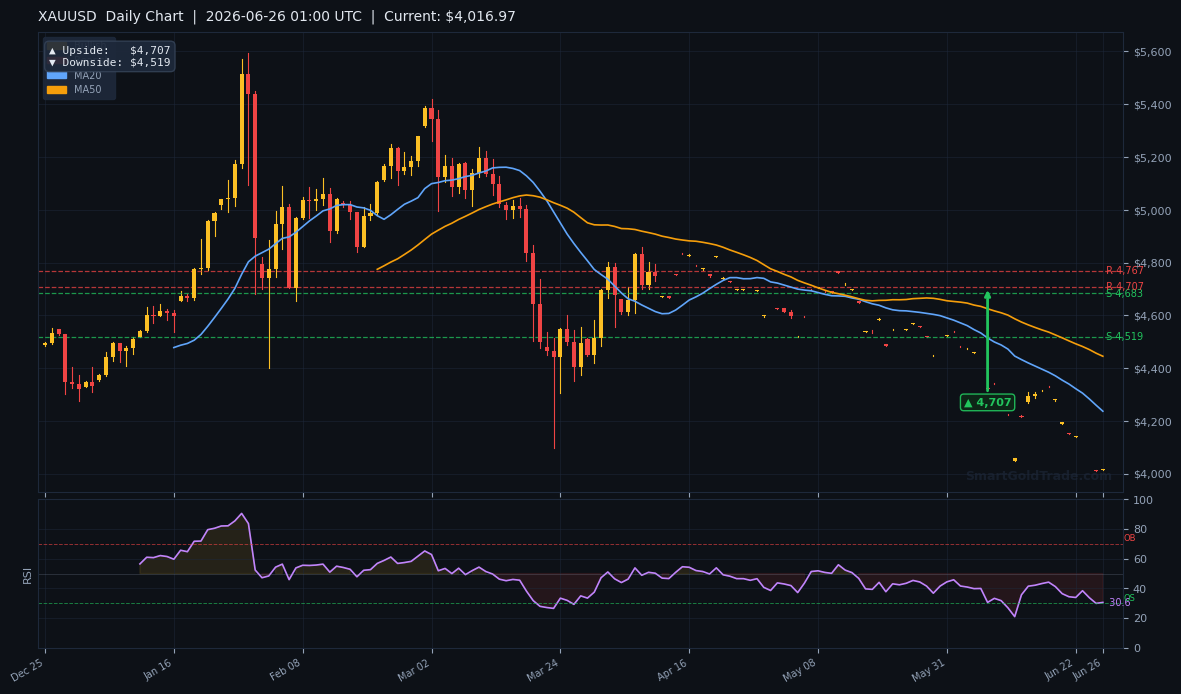
The gold price slipped to $4,016.97 early Friday, nudging dangerously close to the $4,022 support pivot that has defined intraday structure all week. But within a few hours the yellow metal found a bid, recovering to $4,024.08—the live XAU/USD rate as Asian liquidity started to trickle back. Last week’s Japanese capital-flow report showed foreign investment in Japan stocks rebounded to ¥479.4 billion from a prior negative ¥-785.1 billion, a shift that underpinned the yen and added incremental pressure on dollar-denominated gold. With Asian desks thinly staffed and liquidity at its shallowest, the session is already testing whether bears can convert a quiet drift into a clean breakdown or whether dip-buyers will step in once again.
What’s Really Pushing the Gold Price Lower This Morning?
The dip below $4,020 isn’t a random wiggle—it’s the product of three converging forces. First, the yen’s sudden strength caught dollar bulls off guard. When the Japanese currency rallies, the U.S. Dollar Index tends to soften, but counterintuitively that doesn’t always lift gold in the very short term because traders first unwind crowded dollar-yen positions and gold gets caught in the crossfire. Second, the rebound in foreign equity inflows into Japan signals that global fund managers are rotating back into risk assets, temporarily dimming the safe-haven bid that had been supporting the gold price. Third, the market is still digesting the Federal Reserve’s latest minutes, which hinted at a possible pause in rate cuts if inflation stays sticky—keeping real yields elevated and dulling the shine of zero-yield bullion.
None of these drivers are permanent, but when they collide in a thin pre-Tokyo-fix window, the gold price can slide 20 to 30 dollars in minutes without any fresh headline. That’s exactly what we saw, and it’s a textbook reminder that liquidity vacuums amplify every order flow. Smart traders know these windows either trap weak hands or offer the best entry points of the day—provided you have a clear plan.
Critical Support at $4,022 and the Technical Picture Gold Bulls Can’t Ignore
The $4,022 level isn’t just a round psychological number—it’s the 50% Fibonacci retracement of the rally that started in mid-May, and it has acted as a floor on three separate probes over the past seven sessions. A clean hourly close below $4,022 would open the door to the 61.8% retracement at $3,998, a zone that coincides with the 100-hour simple moving average. On the flip side, if the gold price can reclaim $4,035—the top of yesterday’s value area—the intraday bias flips back to neutral and bulls will target $4,058, the swing high from Tuesday.
Volume profile paints a similar story. The point of control since Monday sits at $4,028, meaning most volume has transacted right where we’re hovering now. When price oscillates around the POC, it’s often a springboard for a larger directional move. In practical terms, a break of the $4,022 floor probably triggers stop-loss orders clustered just beneath it, accelerating a move toward $4,000. Conversely, a bounce could be sharp because short-term momentum indicators like the 15-minute RSI are already flirting with oversold territory.
Why the Gold Price Matters Beyond the Charts—A Shariah-Compliant Perspective
For Muslim investors, the gold price isn’t just a ticker to scalp—it’s a gateway to owning a riba-free, tangible asset that has preserved wealth for centuries. Islamic finance principles forbid interest (riba), excessive uncertainty (gharar), and speculative gambling (maysir). That means conventional leveraged forex accounts and CFD brokers are off the table. Instead, Shariah-compliant gold trading requires actual ownership, immediate settlement, and zero overnight swaps. Every dollar the gold price moves carries real meaning because you’re trading physical metal, not a derivative.
Platforms like SmartGoldTrade solve this neatly. Through halal gold trading, you access spot gold markets with gram-based lots, full physical backing, and no interest charges—everything is structured on a musharakah or wakalah model audited quarterly. So when you analyze supports and resistances around a $4,022 pivot, you’re doing it to own real gold, not a paper promise. That changes the entire psychology of trading. A dip to $4,016 isn’t a margin call waiting to happen—it’s a potential opportunity to accumulate an asset you actually hold.
How Capital Flows and Currency Wars Shape Gold’s Next Move
The Japanese capital flow data that helped nudge the gold price lower this morning deserves a closer look. When foreign investors pour ¥479.4 billion into Japanese equities, it signals confidence in the yen and the local recovery story. For gold, this works through two channels. First, a stronger yen makes dollar-priced gold more expensive for Japanese buyers—the world’s third-largest gold consumer—potentially dampening physical demand from Tokyo retail traders. Second, yen strength drags the DXY lower over the medium term, which is actually bullish for gold, but the short-term correlation can invert when carry-trade unwinds accelerate.
We saw this dynamic play out in real time: gold dipped, dollar-yen dropped 30 pips, and the yen crosses bled. Once the flow-driven noise settles, the underlying relationship should reassert itself. Historically, sustained yen appreciation has been a tailwind for the gold price because it loosens the dollar’s grip on safe-haven flows. If the Bank of Japan hints at further rate normalization next week, we could see gold break above $4,060 within days rather than weeks.
How Halal Investors Can Respond to Gold Price Drops Without Crossing Shariah Boundaries
Watching the gold price flirt with a $4,022 breakdown can tempt anyone into emotional decisions. But Islamic trading principles demand a different approach—one rooted in discipline, risk management, and asset-backed reality. Here are three Shariah-compliant ways to act on today’s price action:
- Accumulate physical gold during dips. A price near support is often the cheapest entry point for buyers who plan to hold for the long term. SmartGoldTrade’s physical gold products include 22K coins starting from just 1 gram, 24K bars up to 10 grams, and even artisan gold jewelry—all certified, vaulted, and instantly purchasable. When paper markets panic, owning tangible gold becomes a fortress for your wealth.
- Use limit orders in a halal spot trading account. Instead of chasing price, set a buy limit just above the $4,022 support—say $4,025—with a tight stop under $4,018. Because there’s no leverage and no swap, you never pay interest on an overnight position. This mechanical approach removes emotion and keeps you halal.
- Wait for confirmation before diving in. A single hourly close below $4,022 would be a significant technical event. Patient traders can watch for a bearish flag breakdown or a bullish pin bar reversal on the 30-minute chart before committing capital. The key is to let the market tip its hand, then participate with a defined risk and a clear reward target that doesn’t violate Shariah principles.
For traders who want to refine their entry timing without staring at screens all night, external resources can help. Services that provide professional gold trading signals offer real-time alerts with entry, stop-loss, and take-profit levels analyzed by full-time market specialists. While you must still ensure your broker complies with Islamic finance rules, having a data-driven heads-up on potential breakdowns or reversals can sharpen your own halal trading decisions considerably.
The Bigger Macro Puzzle: Inflation, Central Banks, and the Long-Term Gold Price Trajectory
Stepping back from the intraday drama, the gold price is still up over 14% year-to-date and remains firmly within a secular bull trend driven by sticky global inflation and aggressive central bank buying. The People’s Bank of China paused its gold purchases in May after an 18-month buying spree, but emerging-market central banks collectively added more than 290 tonnes in the first quarter alone. Poland, India, and Kazakhstan continue to diversify away from dollar reserves, creating a structural bid that doesn’t care about a $4,022 pivot. For retail Shariah-compliant investors, this institutional appetite provides a strong tailwind whenever the gold price dips—large players see pullbacks as reloading opportunities, not reasons to dump.
On the rates front, the Fed’s latest dot plot still pencils in one rate cut before year-end, though the timing keeps getting pushed out. Real yields hovering near 2% haven’t broken gold’s back as they did in 2022, primarily because geopolitical fragmentation—Ukraine, Middle East tensions, de-dollarization talks—now adds a persistent risk premium. That premium rarely appears in short-term charts, but it explains why the gold price refuses to collapse even when the dollar firms up. In a Shariah context, this multi-layered demand makes gold one of the purest forms of wealth preservation available to Muslim investors today.
How to Build a Halal Gold Investment Plan That Works Any Gold Price Environment
No matter where the gold price closes this Friday, having a systematic plan is what separates successful investors from gamblers. Shariah-compliant wealth building isn’t about timing every wiggle; it’s about consistent exposure, full ownership, and profit-sharing that aligns with Islamic ethics. SmartGoldTrade offers several avenues that fit different risk appetites:
- Spot trading for active investors. If you enjoy reading charts and want direct control, open a halal gold trading account. You’ll trade gram lots with physical backing, tight spreads, and zero interest. The current volatility around $4,022 is precisely the type of environment where disciplined traders can thrive.
- Musharakah pools for medium-term growth. For those who prefer a hands-off approach, Shariah-compliant investment pools pool capital and share profits quarterly. The gold price appreciation gets distributed as actual profit—not interest—fully audited and transparent.
- Dollar-cost averaging with physical coins. A fixed monthly purchase of 1-gram or 5-gram 22K coins irons out volatility. When the gold price dips, you automatically accumulate more metal for the same fiat amount. Over a 2-3 year horizon, this strategy has historically delivered solid returns while keeping you riba-free.
The beauty of Islamic finance is that it removes the artificial complexity layered by conventional markets. You don’t need CFDs, leverage, or swaps to profit from a $4,022 support test. You need a real asset, a clear plan, and the patience to let the gold price do what it has done for millennia—appreciate as fiat currencies lose purchasing power.
FAQ
Does a falling gold price affect the halal status of my trading account?
No. The Shariah compliance of a gold trading account depends on the contract structure, not the direction of the gold price. As long as your broker uses physical-backed spot trading with no interest, leverage, or speculative derivatives, a drop in gold price simply reflects a change in asset value—not a riba violation.
What’s the best way to buy physical gold when the gold price dips near support?
Setting a budget and purchasing directly through a certified platform that offers vaulted, allocated gold is the cleanest method. Look for products like 22K coins or 24K bars from Shariah-compliant stores so you receive a tangible asset without delayed settlement—this locks in the low gold price instantly.
How can I use technical analysis without falling into gharar?
Gharar refers to excessive uncertainty and ambiguity, not informed decision-making. Analyzing support, resistance, and volume to make a calculated entry is permissible because it reduces ignorance about the market. The key is to avoid highly speculative instruments (like binary options) and stick to actual ownership-based trades where the gold price movement directly translates into asset gains or losses.