Gold price dipped to $3,995.78 early on June 25, 2026, briefly slipping below the psychological $4,000 mark during the typically thin Asian session. Overnight liquidity was scarce, and yesterday's Bank of Japan June meeting summary did little to jolt the metal — the BoJ's cautious inflation outlook nudged the yen slightly higher, but the gold price barely flinched as US Treasury yields held firm and the dollar index stayed flat. Chasing early moves in this environment often leads to whipsaws; patience, not aggression, is the correct posture. The smart play is to let the market confirm a direction near the session's battle-tested levels before committing capital.
Gold Price Overview
Macro Context
Macro conditions remain mildly supportive of the US dollar, keeping the gold price pinned beneath its major moving averages. The DXY continues to hover above 104.50 after last week's hawkish FOMC remarks reinforced the "higher-for-longer" rate story. With the 10-year Treasury yield parked near 4.25%, non-yielding assets like gold face a steady headwind. Still, the gold price is not in freefall. Unresolved friction in Eastern Europe and ongoing US-China trade tensions create a reliable safety net whenever prices dip, so the metal stays trapped between a monetary-policy ceiling and a geopolitical floor.
Session Outlook
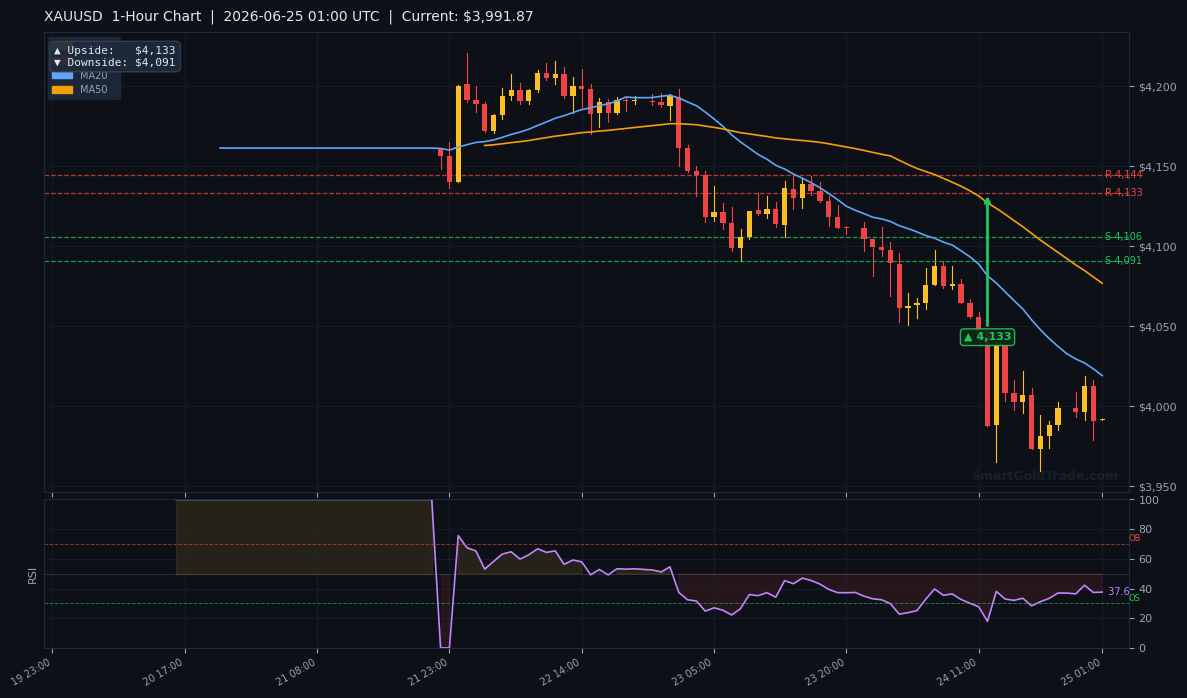
Asian hours are renowned for false breaks, and today's drift below $4,000 is already testing that reputation. Tokyo absorbed the BoJ summary without drama, leaving the gold price to technical flow. With the metal now trading under the earlier 1‑hour pivot support at $4,091, that level has flipped to near-term resistance. The session is likely to revolve around the $4,000 round number; a 15‑minute candle close below it could open the door to $3,980, while a recovery above $4,091 would negate the bearish signal. Range traders may find scalping opportunities, but swing traders should wait for European volume to validate any breakout.
Technical Analysis
Moving Average Structure
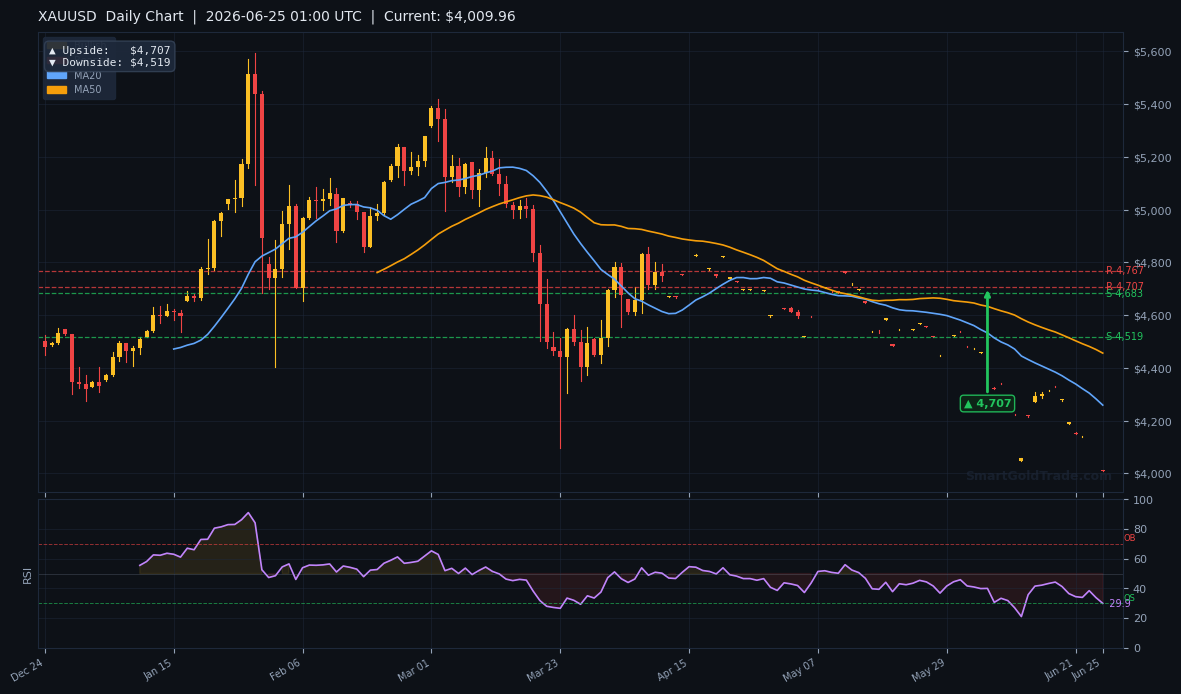
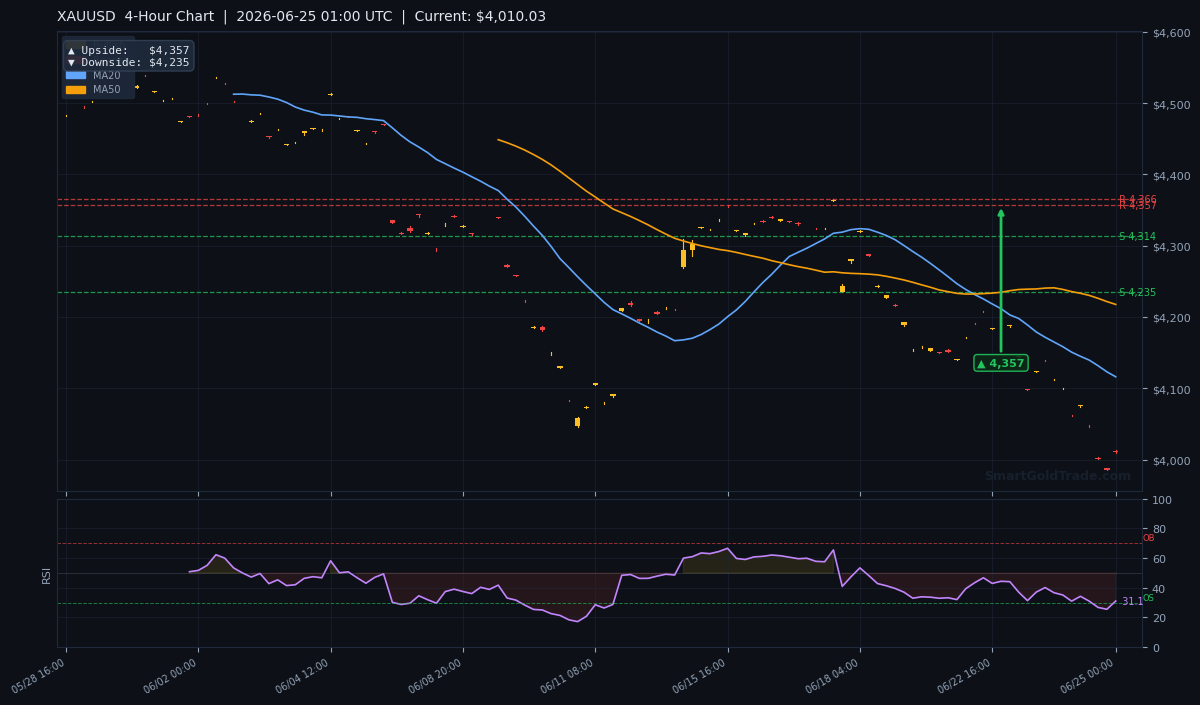
Gold price at $3,995.78 rests decisively below the entire moving average stack. The MA20 at $4,116.12, the MA50 at $4,217.64, and the MA200 at $4,410.11 all slope downward, reinforcing a bearish bias on multiple timeframes. The shorter-term MA20 holding below the MA50 confirms the bearish EMA cross that has guided price action lower since early June. Until XAU/USD reclaims at least the MA20, any rally should be treated as a counter-trend bounce. This alignment keeps sellers firmly in charge for the mid-term.
RSI and Momentum
The 14-period RSI reads 31.1, flirting with oversold territory. While the gold price could still see one final push lower, the RSI suggests selling momentum is exhausted rather than accelerating. A move above 40 would be the first real hint of recovering strength; a dip below 30 would likely trigger a snap-back bounce. For now, the indicator simply confirms the pause, not a reversal.
Key Price Levels
Calculated pivot supports are S1 at $4,313.77 and S2 at $4,234.79; resistance sits at R1 $4,365.61 and R2 $4,356.90. Note that R2 is fractionally below R1, creating a resistance cluster near $4,357–$4,365 that could cap any attempted rally. The daily ATR of $25.80 projects an expected fluctuation of roughly 0.64%, and with the gold price now below the 1‑hour downside target of $4,091, intraday focus shifts to the psychological $4,000 handle and the $3,980 zone — a level that aligns with the ATR projection. The 4‑hour chart's targets remain at $4,357 upside and $4,235 downside, while the daily chart points to $4,707 and $4,519 respectively. For practical Asian session trading, the immediate band to watch is $4,000 on the support side and $4,091 as resistance.
| Timeframe | Support | Resistance | Pivot Target |
|---|---|---|---|
| Daily | $4,519 | $4,707 | — |
| 4-Hour | $4,235 | $4,357 | — |
| 1-Hour | $4,091 | $4,133 | — |
Fundamental Drivers
The primary fundamental input this session remains yesterday's Bank of Japan June meeting summary. BoJ members acknowledged upside inflation risks but stressed that policy normalization must be gradual; the yen firmed modestly, though the gold price barely registered it because US rate expectations dominate. The Federal Reserve's signaling of a prolonged pause continues to cap gold upside — last week's FOMC minutes underscored that rate cuts are unlikely before September, keeping the opportunity cost of holding gold elevated. Geopolitical uncertainty provides a safety net: the Russia-Ukraine conflict and trade tensions between Washington and Beijing ensure that safe-haven bids emerge whenever gold dips below psychological marks like $4,000. This push-pull dynamic keeps the gold price in a broad range, albeit with a downward tilt.
Key Event to Watch
This week's most consequential data point is the US PCE price index, scheduled for Friday. The core PCE measure is the Fed's preferred inflation gauge. A soft reading could revive speculation about an earlier rate cut, weakening the dollar and sending the gold price toward the $4,091 resistance. Conversely, a hot number would reinforce the hawkish stance, likely driving XAU/USD through $4,000 and toward the $3,980 demand zone. Position sizing ahead of the release should be conservative.
Devil's Advocate
The bearish thesis weakens considerably if the gold price reclaims the $4,091 level on a 1‑hour closing basis. Such a move would indicate a short‑term bottom and could ignite a swift rally toward the 4‑hour upside target at $4,357. A daily close above the MA20 at $4,116.12 would be the first technical sign that sellers are losing control.
On the flip side, a sharp dip below $4,000 that immediately reverses would be a classic liquidity grab — a scenario that traps breakout shorts and punishes premature sellers. In either case, waiting for confirmation on volume is essential before drawing conclusions about the next leg.
Trading Strategy for Asian Session
With the gold price testing the $4,000 support after slipping under the 1‑hour pivot, the session strategy should center on a $3,980–$4,091 range. Aggressive traders might consider a long position on a confirmed bounce from $4,000, placing a stop loss at $3,975 (roughly a full ATR below the round number) and a take-profit order at $4,091.
For bears, a clean breakdown below $4,000 that holds for a full 15‑minute candle opens the door to a short entry, with a stop at $4,025 and targets at $3,980 and $3,950. However, because Asian volume is notoriously thin, any break should be treated with skepticism until confirmed by European or early US flow.
Traders who want to avoid overnight swap fees can execute these setups through halal gold trading on our Shariah‑compliant platform, which eliminates riba and keeps positions fully compliant. For those who prefer real‑time institutional‑style alerts on these exact levels, professional gold trading signals deliver entry, stop, and target updates directly.
Turning the Gold Price Dip into a Physical Asset Opportunity
When the gold price retreats to the $4,000 neighborhood, long‑term savers often see value. Physical gold — 22K coins, 24K bars, or certified jewelry — provides a tangible hedge against currency depreciation and inflation, and it doesn't depend on margin or leverage. If you believe the current weakness is temporary, you can purchase physical gold from our fully insured, Shariah‑compliant store while prices are subdued. Unlike spot trading, holding physical metal incurs no overnight fees and fits naturally into a diversified, riba‑free portfolio.
Key Takeaways
- Gold price at $3,995.78 sits beneath the MA20, MA50, and MA200, reinforcing a multi‑timeframe bearish structure.
- RSI at 31.1 signals weak momentum but leaves room for a final push lower before oversold conditions emerge.
- Asian session range now pivots around $4,000 support — a break below could target $3,980; a push above $4,091 would invalidate the immediate bearish bias.
- ATR of $25.80 suggests a daily range that easily spans the $3,980–$4,091 zone, so stops should be placed with that volatility in mind.
- Friday's US PCE report is the make‑or‑break event this week, capable of driving a breakout or deepening the sell‑off.
- False breaks are common in thin liquidity; use a 15‑minute close filter to avoid whipsaws.
Conclusion
Gold price holds a bearish tilt as the Asian session unfolds beneath critical moving averages and the $4,000 handle. The immediate battle lines are drawn at $4,091 on the upside and $4,000 on the downside — until one gives way with conviction, the market will likely chop in a narrow band. Patient traders will preserve capital by waiting for a confirmed breakout and using the upcoming PCE data as a directional catalyst. The next 24 hours are about preparation, not execution. Those who respect the thin liquidity and avoid chasing early moves will be best positioned when the real volume arrives.
FAQ
- What is the gold price forecast for today's Asian session?
- Gold is expected to test the $4,000 support, with resistance now at $4,091. A breakout beyond either level would set the intraday direction, but thin liquidity makes false moves likely.
- Is XAU/USD in a bearish trend?
- Yes. The gold price at $3,995.78 sits below all three major moving averages — MA20 at $4,116.12, MA50 at $4,217.64, and MA200 at $4,410.11 — confirming a bearish mid‑term structure.
- What economic event could move gold price this week?
- The US PCE price index release on Friday is the most significant risk event. A softer reading could push gold toward $4,091, while a hotter print may drop it below $4,000 toward $3,980.
Trading Gold (XAU/USD) carries significant risk of loss and is not suitable for all investors. This content is for informational purposes only and does not constitute financial advice. Always conduct your own research and trade responsibly.