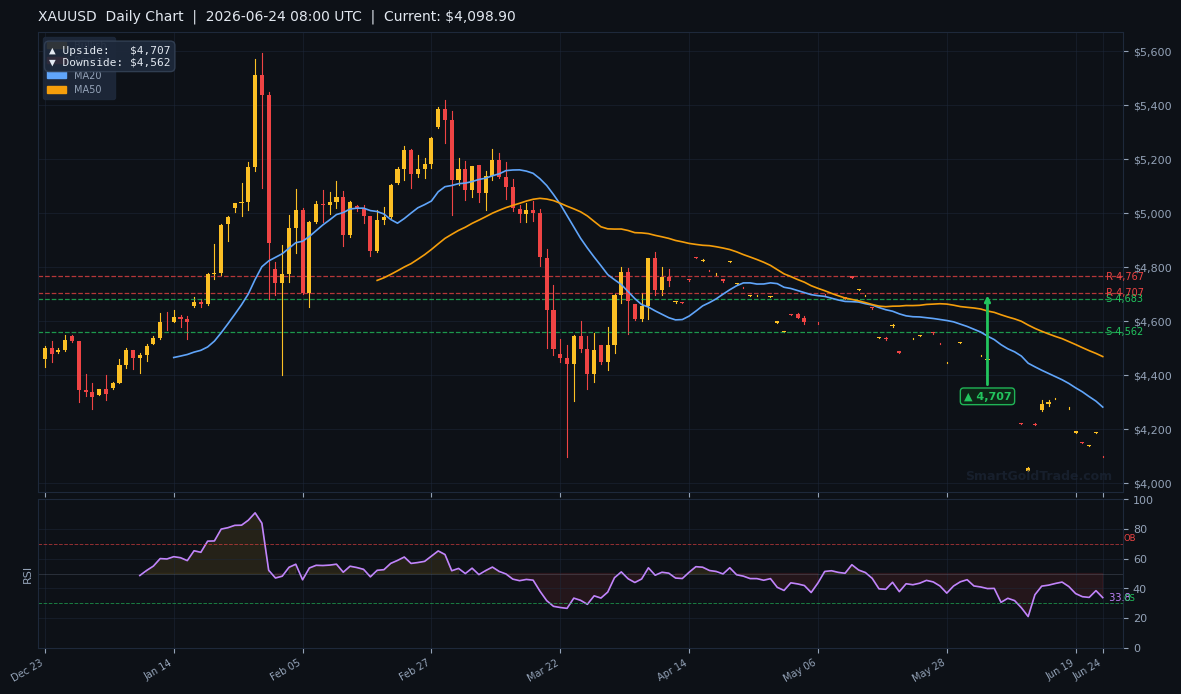
Gold price is under aggressive selling pressure this European morning, with spot XAU/USD slipping to $4,061.00 per troy ounce at 10:30 UTC after a heavy breach of the $4,065 barrier in the first hour of London trade. Germany’s HCOB Manufacturing PMI printed a clear miss, triggering a swift US dollar bid that yanked the rug from any overnight bounce. The data-driven dump has traders wondering whether this is a genuine directional shift or just a liquidity sweep before the next leg higher. Across charts, fundamentals, and order flow, multiple signals are aligning that suggest the downside may still have room to run — and Shariah-compliant traders need to pay attention.
Gold Price Technical Snapshot: A Bearish Structure Takes Hold
The daily chart paints an uneasy picture. After weeks of grinding consolidation near the $4,120–$4,140 resistance cluster, today’s gold price breakdown slices cleanly through the 20-day exponential moving average and the psychological $4,100 handle. That level had acted as a pivot since mid-May, and losing it on a 4-hour closing basis turns it into immediate resistance. The next logical demand zone sits between $4,045 and $4,030, where buyers stepped in during two previous dips in early June. A failure there would open the door to a test of the 50-day simple moving average around $3,988.
Volume profiles on the 1-hour chart reveal a surge of selling above 2,200 lots within the $4,075–$4,065 bracket, indicating institutional distribution rather than mere stop-hunting. The intraday relative strength index (RSI) has dipped to 32, not yet oversold, which leaves room for another leg lower before any mean-reversion bounce. The message is clear: sellers own the short-term momentum, and any bounce that stalls below $4,100 will likely be seen as a selling opportunity.
Why the Dollar Is Squeezing Bullion Right Now
The catalyst is simple but powerful. Germany’s manufacturing PMI came in at 42.8 against a consensus of 44.1, reinforcing fears that Europe’s industrial engine is stalling. With the euro sliding 0.4% against the dollar, the DXY index punched through 104.80, making dollar-denominated gold more expensive for non-USD buyers. But beyond the headline, the market is repricing rate differential expectations. Futures markets have started trimming bets on a September Federal Reserve rate cut, and two-year Treasury yields ticked up 4 basis points — both classic headwinds for the non-yielding metal.
Eurozone-wide PMIs are still ahead, and if those numbers also miss, the greenback could get a second wind. Historically, gold struggles when real yields rise and the dollar strengthens simultaneously. Traders who rely on professional gold trading signals often use these macro divergences to time entries, and today’s setup is no different.
Order Flow and Positioning Clues
A deeper look at the COMEX futures tape shows a build-up of sell stops below $4,060, many of which have already been triggered. Open interest data from yesterday’s close indicated that managed money had added fresh long positions near $4,130, and those positions are now underwater. Forced liquidation from late longs could accelerate the decline toward the $4,020 area, where the 100-day moving average resides. On the flip side, if bids at $4,045 hold, a short-squeeze bounce might retrace 50% of today’s drop, but that remains a counter-trend play.
One telling sign is the gold-silver ratio, which spiked to 87.5 from 86.2 overnight. That kind of divergence usually confirms that gold’s fall is liquidity-driven rather than a broad commodity sell-off. For disciplined traders, watching how the ratio behaves around the 88 level can signal whether the move is exhausting.
Relevance for Shariah-Compliant Investors
For Muslims who trade or invest in gold, a sell-off like this raises two questions: is it halal to act, and how to do it without violating Islamic finance principles. Spot gold trading that involves immediate physical ownership and no riba (interest) aligns with Shariah law when structured correctly. Our halal gold trading platform enables precisely that — no leverage, no swap fees, and direct allocation of gram lots backed by physical bullion. In a falling market, that means you can short gold synthetically by first selling spot metal you own, or simply wait for a low-risk buying opportunity without worrying about haram overnight charges.
Meanwhile, long-term investors often view sharp corrections as a chance to accumulate physical metal. Dips below $4,100 historically have attracted strong buying from central banks and retail alike. If you prefer to own the asset outright, you can purchase physical gold in certified 24K bars or 22K coins, which continues to be a sunnah-compliant store of wealth. Combining a physical holding with a Shariah-compliant trading account gives you the flexibility to hedge without compromising your aqidah.
Key Levels to Watch for the Rest of the Day
The gold price reaction around $4,045 will determine the short-term bias. A convincing break below that support opens a path to $4,010 and possibly the psychological $4,000 round number. On the upside, bulls need to push price back above $4,085 to neutralise the intraday downtrend and target $4,100 again. With the U.S. session yet to come, traders should also monitor the ISM Manufacturing PMI due at 14:00 UTC. A stronger-than-expected print would likely push gold under $4,030, while a miss could spark a relief rally back toward today’s breakdown point.
For traders following ethical strategies, this is not about chasing panic but about aligning with price action. A well-structured plan — one that respects Shariah compliance and proper risk management — can turn a volatile morning into a controlled opportunity. Whether you’re executing short-term trades through a halal spot account or accumulating physical coins during the dip, staying level-headed and data-driven is the real edge.
FAQ
Why did gold price fall today?
The gold price dropped sharply after Germany’s manufacturing PMI missed expectations, strengthening the U.S. dollar and pushing yields higher. That double headwind made non-yielding gold less attractive and triggered stop-loss orders below $4,065.
Is it halal to trade gold during a sell-off?
Yes, as long as the trade follows Islamic finance principles. This means spot transactions with immediate delivery, no interest (riba), and no excessive uncertainty (gharar). Platforms offering riba-free spot gold trading enable Muslims to act on price moves without compromising their faith.
What is a safe entry level for gold after this drop?
From a technical standpoint, the $4,045–$4,030 zone represents a strong demand area that held on multiple occasions. Many traders wait for a confirmed bullish reversal pattern in that region before considering a long position. Always combine technical levels with solid risk management and never risk more than you can afford to lose.