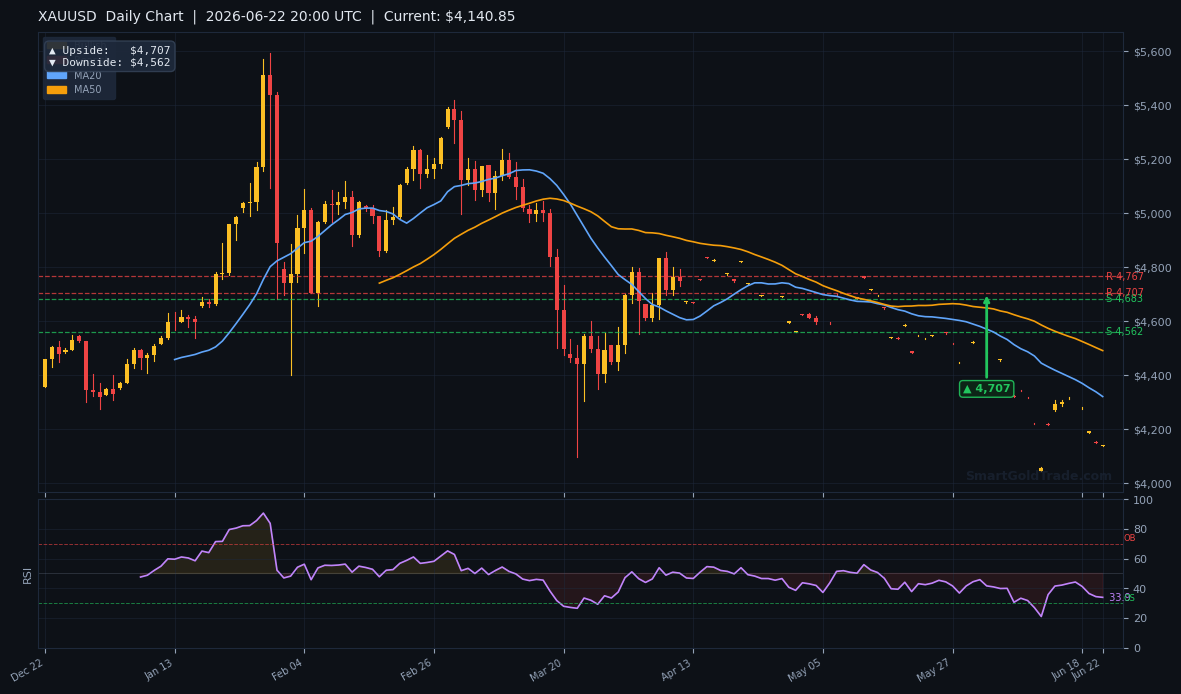
At $4,190.55, gold price is sliding toward a critical technical floor as the American session kicks off. The XAU/USD pair already dropped below the $4,200 psychological barrier earlier and is now testing short-term support near the $4,235 level. This comes months after the brutal 17% gold price plunge in March that shattered long-term support and reset bearish expectations. Today's session follows a quiet Asian and London trade, leaving New York to set the directional tone. With the US dollar firm and Treasury yields hovering near multi-week highs, bearish momentum appears intact. Traders now ask: is $4,235 the next stop for gold price before a potential bounce, or will sellers push deeper into the summer lows?
Gold Price and Market Overview
Macro Context
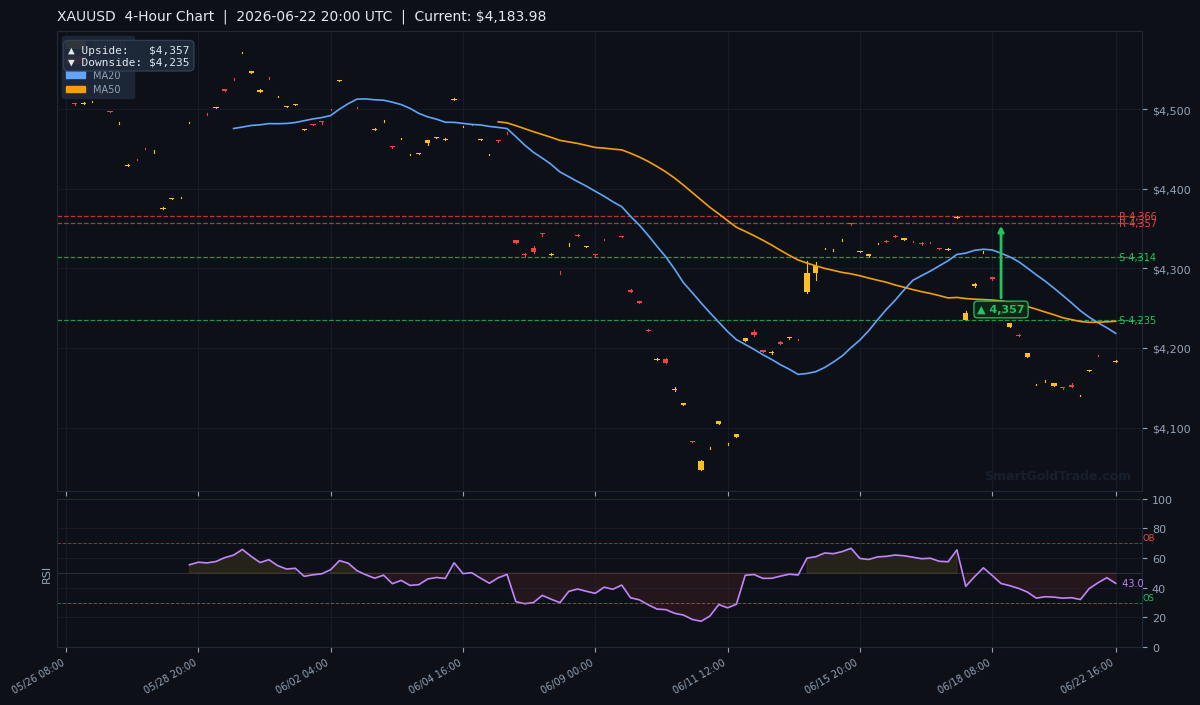
The US Dollar Index (DXY) remains elevated above 104.5, reflecting persistent hawkishness after last week's Federal Reserve commentary. The Fed's June decision to hold rates steady but signal fewer cuts this year has kept gold on the defensive. The 10-year Treasury yield sits near 4.35%, reinforcing the opportunity cost of holding non-yielding gold. Geopolitically, the US-Iran peace deal reached earlier this quarter has doused some safe-haven demand, removing the risk premium that previously supported gold price above $4,300. The accord erased roughly $50–$70 in geopolitical bid that had been baked into gold for months. These factors combine to create a hostile environment for gold bulls, who are struggling to reclaim even the 20-day moving average at $4,218.
Session Outlook
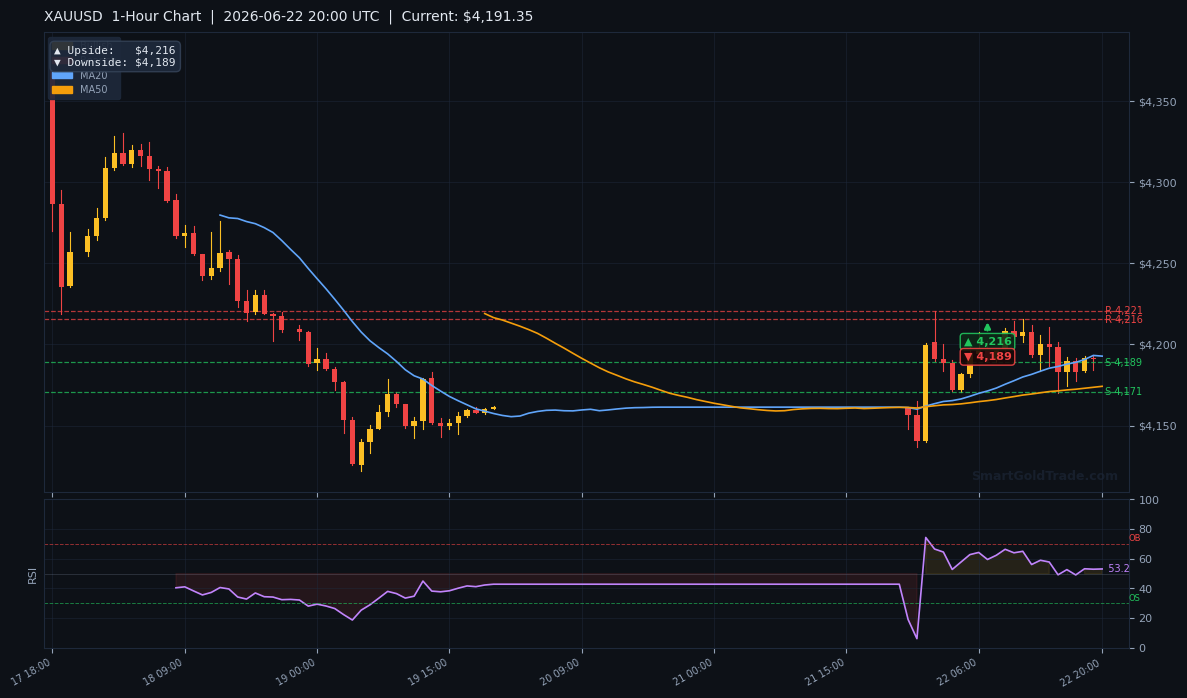
The American session typically brings the largest liquidity and most pronounced moves of the day. With no high-impact US economic data scheduled for Monday, price action will likely be driven by technical flows and position squaring ahead of the Core PCE release on Friday. The intraday expected range, based on the ATR of $19.62, places gold between $4,164 and $4,203. A break below the session low at $4,180 could accelerate selling toward the $4,235 target zone. Conversely, any push above $4,218 would suggest short-covering, but the overall trend remains bearish unless price reclaims the $4,313 support-turned-resistance.
Technical Analysis
Moving Average Structure
Price is currently $4,190.55, trading well below the 20-period simple moving average at $4,218.31 and the 50-period SMA at $4,233.49. The arrangement MA20 < MA50 confirms short-term bearish pressure. The 200-period SMA, a longer-term trend anchor, sits far above at $4,453.00, indicating that the broader technical damage from the March selloff remains unresolved. Until price can conquer the $4,233 zone, any rally should be viewed as corrective within a downtrend.
RSI and Momentum
The 14-period Relative Strength Index reads 43.0, stuck in neutral territory but leaning bearish. Momentum oscillators show no divergence, suggesting that the downward move has room to run before becoming oversold. A drop in RSI below 30 would indicate exhaustion, but for now the indicator supports further probing of lower supports.
Key Price Levels
Immediate support rests at S1 at $4,313.77, but that level is now distant after the break below $4,200. The more actionable floor is S2 at $4,234.79, which aligns with the 4-hour chart's downside pivot target of $4,235. Resistance above comes first at R1 at $4,365.61, which would need to be cleared to negate the bearish structure. The ATR of $19.62 suggests an intraday volatility envelope of approximately $39, keeping a $4,160 – $4,200 band in play.
| Timeframe | Upside Target | Downside Target |
|---|---|---|
| Daily | $4,707 | $4,562 |
| 4-Hour | $4,357 | $4,235 |
| 1-Hour | $4,216 | $4,189 |
Fundamental Drivers
The gold price's vulnerability traces back to the 17% crash in March, when XAU/USD sliced through the $4,500 support like butter, as reported by FOREX.com. That breakdown exposed stops and accelerated a long-overdue correction from overbought conditions. Since then, every rally has been sold, a pattern reinforced by the Federal Reserve's resolve to keep rates elevated. The US Dollar Index has gained 3.2% since the March low, pressuring commodities across the board. Meanwhile, the US-Iran peace accord removed a geopolitical bid that had underpinned gold for months. The net effect is a market where buyers are hesitant to step in front of a freight train of dollar strength and higher real yields.
The March gold price crash erased more than $800 in a matter of days, breaking a multi-year uptrend that had driven XAU/USD to record highs in 2025. The severity of the selloff shifted market psychology from "buy the dip" to "sell the rally," a pattern that still dominates. Even the traditional safe-haven support from central bank gold purchases slowed in Q2, leaving the metal exposed to macro headwinds. As long as the dollar holds its gains, the path of least resistance for gold price is lower.
Key Event to Watch
This week's marquee event is Friday's Core PCE Price Index, the Fed's preferred inflation gauge. Consensus expects a sticky reading near 3.6% year-on-year. A hotter-than-expected number could cement expectations that rate cuts are off the table for 2026, potentially sending gold price below $4,200 and toward the $4,150 zone. Conversely, a downside surprise might offer bulls a lifeline to challenge $4,235 from below.
Devil's Advocate
The bearish thesis breaks down if gold price reclaims the $4,313.77 level, which represents the former support S1 and now a formidable resistance. A daily close above that pivot would indicate a false breakdown and could trigger a short-squeeze back toward the $4,365 area. Additionally, if the Core PCE data surprises sharply to the downside, dollar bulls may capitulate, giving gold the momentum to challenge the 50-day MA at $4,233. Until either technical or fundamental catalysts emerge, however, the path of least resistance remains lower.
Trading Strategy for American Session
For traders looking to capitalize on the bearish momentum, a sell-on-rally approach is favored. Entry could be considered near the $4,200 psychological level, which aligns with intraday rolling resistance and the lower edge of the prior range. A stop-loss above $4,235 — the S2 support turned resistance — would protect against a short-squeeze, risking roughly $35 per ounce. Using the ATR of $19.62, that stop is less than two daily ranges, keeping risk in check.
For those who prefer a hands-off approach, copy trading lets you mirror seasoned gold traders without manual execution. If short-selling doesn't align with your investment principles, SmartGoldTrade's halal gold trading platform offers direct physical ownership with zero interest and no leverage. To fine-tune entry timing, professional gold trading signals provide real-time alerts that complement your own analysis.
Key Takeaways
- Gold price is trading at $4,190.55, below all major moving averages, signaling persistent bearish pressure.
- The MA20 at $4,218 and MA50 at $4,233 act as near-term obstacles; a close above $4,313 would shift bias.
- Key support to watch this session is $4,235 (S2), with a break targeting $4,150 next.
- RSI at 43 leaves room for further downside before reaching oversold conditions.
- Friday's Core PCE report is the week's primary event risk, capable of accelerating or reversing the downtrend.
- The ATR of $19.62 suggests an average intraday range of $39, providing structure for stop and target placement.
Conclusion
Gold price enters the American session under heavy bearish pressure, with technicals aligning against bulls. The break below $4,200 opens the door to the $4,235 support, a level that must hold to prevent a slide toward $4,150. While oversold readings are absent, the RSI's neutral stance suggests sellers remain in control. The macro backdrop — a strong dollar, elevated yields, and a dovish geopolitical landscape — continues to weigh on the yellow metal. Friday's inflation data could either reinforce this trend or spark a reversal, but for now, the weight of evidence points lower. Traders should respect the bearish structure, using rallies as opportunities to sell and keeping stops above $4,235. The gold price trajectory depends on whether bulls can reclaim the $4,313 pivot; until then, caution is warranted.
FAQ
- Why is gold price falling despite geopolitical tensions?
- Gold price has been under pressure because the US-Iran peace deal reduced safe-haven demand, while a strong Dollar and elevated Treasury yields make gold less attractive. These factors outweigh residual geopolitical risks.
- What is the next support level for XAU/USD?
- The immediate downside target is $4,235, which is the S2 support on the 4-hour chart. A breakdown there could expose $4,150 and the March low near $3,900.
- How does the Core PCE affect gold trading?
- The Core PCE is the Fed's favored inflation measure. A higher reading could push yields higher and gold lower, while a miss may trigger a dollar sell-off and lift gold toward $4,235 resistance.
Trading Gold (XAU/USD) carries significant risk of loss and is not suitable for all investors. This content is for informational purposes only and does not constitute financial advice. Always conduct your own research and trade responsibly.