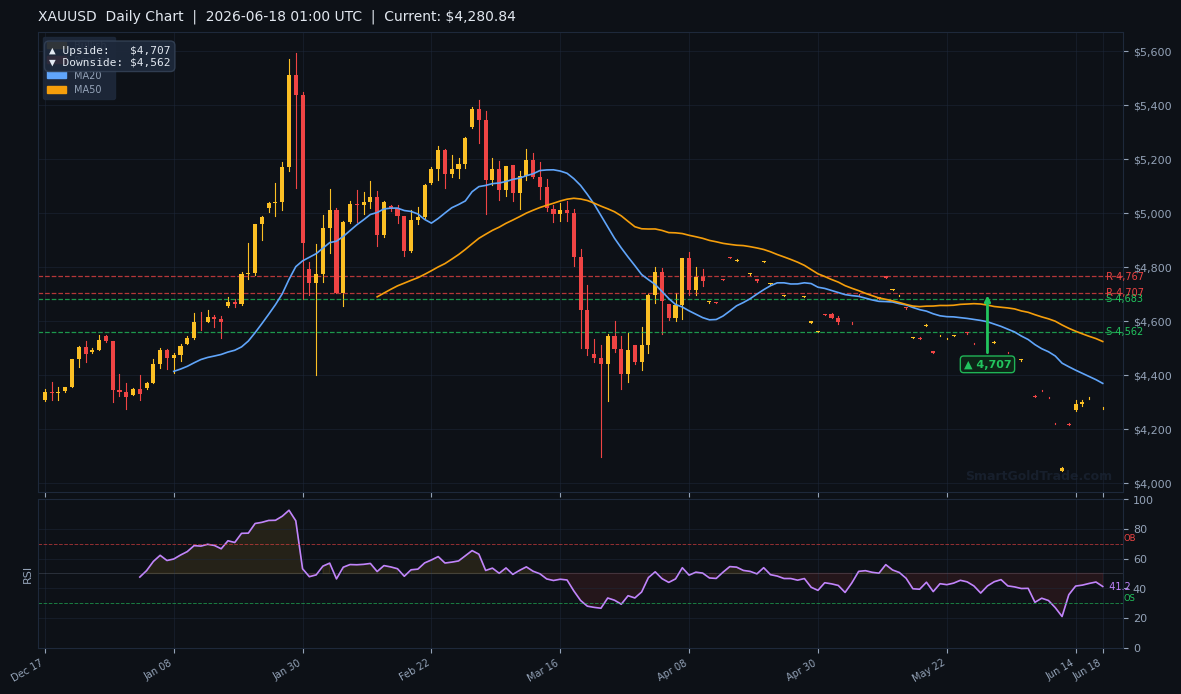
On June 18, 2026, the spot gold price sits at $4,324.60 per troy ounce as Asian trading unfolds—a deceptively quiet number concealing a powder keg of anticipation. The 4-hour XAU/USD chart reveals price hugging the $4,320 support level, with the weekend low at $4,280.84 still standing as the line in the sand. Institutional traders and retail speculators have wound down risk ahead of the Federal Reserve’s interest rate decision and U.S. May retail sales data, creating razor-thin liquidity that won’t last long.
Gold Price Today: The Calm Before the Fed Storm
Macro Backdrop
The U.S. Dollar Index (DXY) lingers near 104.50, and the 10‑year Treasury yield is glued to 4.30%, both creating a stalemate for the gold price. When the dollar fails to break higher and yields refuse to spike, gold lacks a directional nudge, forcing it to drift sideways. This deadlock has persisted for three sessions, sapping momentum from both bulls and bears.
Institutional traders are trimming speculative longs, as reflected in declining COMEX open interest. Hedge funds that built a sizeable gold position earlier in June are now cutting exposure to avoid getting caught on the wrong side of a hawkish surprise. The result is a gold price that clings to the $4,320 area like a magnet, absorbing random noise but refusing to commit.
Inflation Whiplash
Last week’s U.S. inflation data painted a conflicting picture. The Consumer Price Index (CPI) came in slightly below consensus, hinting that restrictive policy is finally cooling price pressures. Yet the Producer Price Index (PPI) rose more than expected, reminding everyone that inflation’s last mile remains stubborn.
The gold price initially surged on the CPI print, only to erase gains as PPI revived Fed-hawk fears. This tug-of-war explains why XAU/USD hasn’t broken its week‑long range. A market that cannot agree on the inflation trajectory trades headlines, making today’s dot plot and retail sales figures the ultimate tiebreakers.
Technical Analysis: Mapping the Gold Price’s Next Move
From a pure chart standpoint, the gold price is carving a classic consolidation wedge on the 4‑hour timeframe. Lower highs from the $4,500 all‑time high region converge with a resilient floor near $4,280, forming a narrowing triangle that demands resolution. As the pattern nears its apex, the probability of a sharp breakout rises quickly.
- Immediate Support: $4,320 (Monday’s low), followed by $4,280 (structural base).
- Immediate Resistance: $4,365 (multiple swing highs), then $4,400 (round number and prior range floor).
- Momentum: The 14‑day RSI hovers at 48, neutral but leaning bearish; the MACD histogram is flatlining near zero.
A daily close above $4,365 would confirm a bullish reversal and open a path toward $4,400 and potentially $4,500. A breakdown below $4,320, however, could accelerate toward the 50‑day exponential moving average at $4,200, where structural buyers are likely waiting. Volume profiles show a high-volume node at $4,310–$4,330, explaining the magnet effect currently anchoring the gold price.
Savvy traders who don’t have time to chart every candle often supplement their analysis with professional gold trading signals. When the gold price rips through levels in the 10 minutes following the FOMC statement, real‑time entry and stop alerts can help lock in a clean fill without chasing a parabolic move.
The FOMC and Retail Sales: A Double Whammy for XAU/USD
The Federal Reserve’s June meeting is all about the dot plot. While the fed funds rate will almost certainly stay at 5.25–5.50%, the interest‑rate projections for 2026 and beyond will dictate dollar direction. If policymakers shift the median projection to fewer cuts, the dollar may spike, pushing the gold price below nearby support.
Simultaneously, U.S. May retail sales are forecast to rise 0.3% month‑over‑month. A negative print would stoke recession fears and send safe‑haven flows flooding into gold. The one‑two punch of these events means the gold price is likely to escape its cage within minutes of the data release, creating both opportunity and danger for unprepared traders.
Halal Gold Trading: Playing the Gold Price Without Breaking Islamic Law
Mainstream gold trading often relies on CFDs—derivatives that involve overnight swap fees (riba) and excessive leverage, both of which are prohibited in Islam. The Quranic prohibition of riba extends to any interest‑bearing instrument, and leveraged products introduce gharar (excessive uncertainty). Shariah scholars agree, however, that trading physical gold on a spot basis, where ownership is immediate and hand‑to‑hand, remains permissible.
SmartGoldTrade’s halal gold trading platform brings this principle to modern markets. Each trade corresponds to fractional ownership of real vaulted gold, eliminating counterparty risk and interest. You can go long or short using gram‑based lot sizes, with no overnight fees, and all transactions are audited by a Shariah board.
This model lets Muslim traders capitalize on gold price swings—like the possible breakout today—without compromising their faith. The platform even offers immediate settlement, so your trade finalizes within minutes, mirroring the spirit of traditional sarf (currency/gold exchange) contracts.
Building a Long-Term Gold Portfolio the Shariah Way
Trading the gold price around FOMC meetings suits active participants, but many halal‑conscious individuals prefer time and compounding over screen‑time. Here, mudarabah and musharakah structures come into play, allowing investors to pool capital and share real profits from skilled gold trading.
SmartGoldTrade’s Shariah-compliant gold investment pools run on a musharakah partnership model where profits and losses are shared according to capital contribution. These pools are managed by professional traders who use the same spot, riba‑free approach, aiming for 4–8% annual returns over 6‑month to 3‑year terms. Quarterly Shariah audits ensure ongoing compliance.
Instead of staring at charts, you can benefit from gold price appreciation through a diversified basket of trades executed by experts. It’s a practical way to add gold exposure to a halal portfolio without the emotional rollercoaster of day trading.
Risk Management Toolkit for Gold Price Breakouts
Volatility events like FOMC and retail sales can turn a small gold price movement into a $50 rip or dip in seconds. Protecting capital starts with strict position sizing—never risk more than 1% of your account on a binary event. Even if you’re certain of a breakout, the initial whip can take out loose stops before the real trend begins.
Setting stops at logical levels—just below $4,320 support for longs, or above $4,365 resistance for shorts—prevents one news headline from decimating your account. Some traders also use automated news filters that temporarily pause active orders during high‑impact announcements, reducing the chance of slippage. Disciplined risk management turns the gold price’s wildest swings from threats into opportunities.
Gold Price FAQ
1. What are the main drivers behind today’s gold price?
The gold price today is being shaped primarily by the upcoming Federal Reserve interest rate decision and the U.S. retail sales report. The Dollar Index near 104.50 and 10‑year yields around 4.30% are also holding gold in a tight range until a clear catalyst emerges.
2. How could the Fed decision affect the gold price?
If the Fed’s dot plot signals fewer rate cuts, the dollar may strengthen and push the gold price lower. Conversely, a dovish surprise or soft economic projections would likely weaken the dollar, sending gold above the $4,365 resistance level.
3. Is there a halal way to trade or invest in gold price movements?
Yes, Shariah‑compliant gold trading focuses on spot gold with physical backing, zero leverage, and no interest. Additionally, Islamic investment pools allow you to benefit from gold price growth over longer periods through profit‑sharing structures that avoid riba.