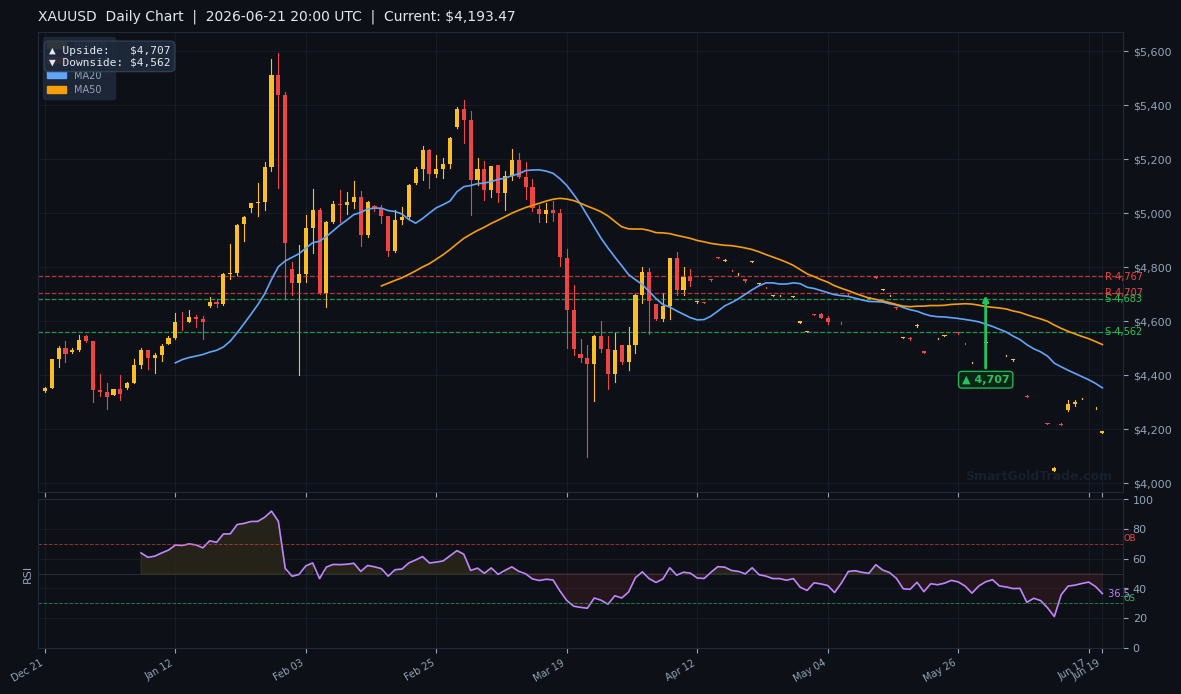
The gold price is trading at $4,151.91 per troy ounce on June 21, stuck below a short-term pivot that has capped every minor bounce since last week’s hawkish FOMC meeting. Treasury yields are grinding higher and the dollar index refuses to break, keeping XAU/USD under the $4,162 resistance. The American session tends to provide the most liquid window for a breakdown, and the chart structure today sets up a clear risk-defined short opportunity. With no major U.S. data due this afternoon, price action around the $4,162 level will dictate the next leg toward the $4,235 target.
Gold Market Overview
Macro Context
The U.S. Dollar Index has been climbing steadily since the Federal Reserve’s June 16-17 meeting, where policymakers signaled at least one more rate hike in 2026 and a slower path for cuts. This hawkish repricing pushed the 10-year Treasury yield above 4.5%, making yield-bearing assets more attractive and stripping gold of its seasonal safe-haven bid. The gold price currently reflects that drag, unable to reclaim even the $4,300 level that analysts had pegged as a line of support only a week ago.
On the geopolitical front, the U.S.-Iranian de-escalation that briefly lifted gold late last week has lost its adrenaline effect. Markets have absorbed the news and shifted focus back to real interest rates and the Fed’s dot-plot. That leaves the gold price vulnerable to any fresh dollar strength or a break of the $4,150 area where spot prices currently sit according to live chart data.
Gold Price Session Outlook
The American session typically brings the heaviest volume and sharpest intraday swings. Today’s calendar is light, but that often means technical levels dominate. I expect gold to probe the $4,162 hourly resistance early; a failure to break above it will invite algorithmic selling that could accelerate toward the $4,235 4-hour pivot. A daily ATR of $32.30 suggests an intraday range of roughly $4,130 to $4,195, giving plenty of room for a short trade to play out.
Gold Price Technical Analysis
Moving Average Structure
The moving averages on the 4-hour chart paint a conflicted picture. The 20-period MA sits at $4,265.94 and the 50-period MA at $4,237.89. Price is below both, a bearish sign for the medium term. Yet the MA20 is still above the MA50, which indicates that short-term momentum hasn’t completely rolled over. This temporary bullish alignment is exactly the kind of trap that catches late longs — it looks like a bottom, but it lacks the volume to push the gold price through the $4,162 ceiling.
The longer-term 200-period MA at $4,468.82 is miles above current levels, confirming that gold is in a corrective phase within a broader bull run. Until the price can recapture the $4,315 zone, the path of least resistance stays lower.
RSI and Momentum
The 14-period RSI reads 33.0, which is neutral but close to oversold territory. At this level, the RSI doesn’t signal an imminent bounce; it simply shows that selling pressure hasn’t reached exhaustion yet. This leaves the door open for another push lower before any meaningful reversal in the gold price. Momentum oscillators on the 1-hour chart are flat, suggesting that the American session will need a catalyst — likely a rejection at $4,162 — to spark the next leg.
Key Price Levels
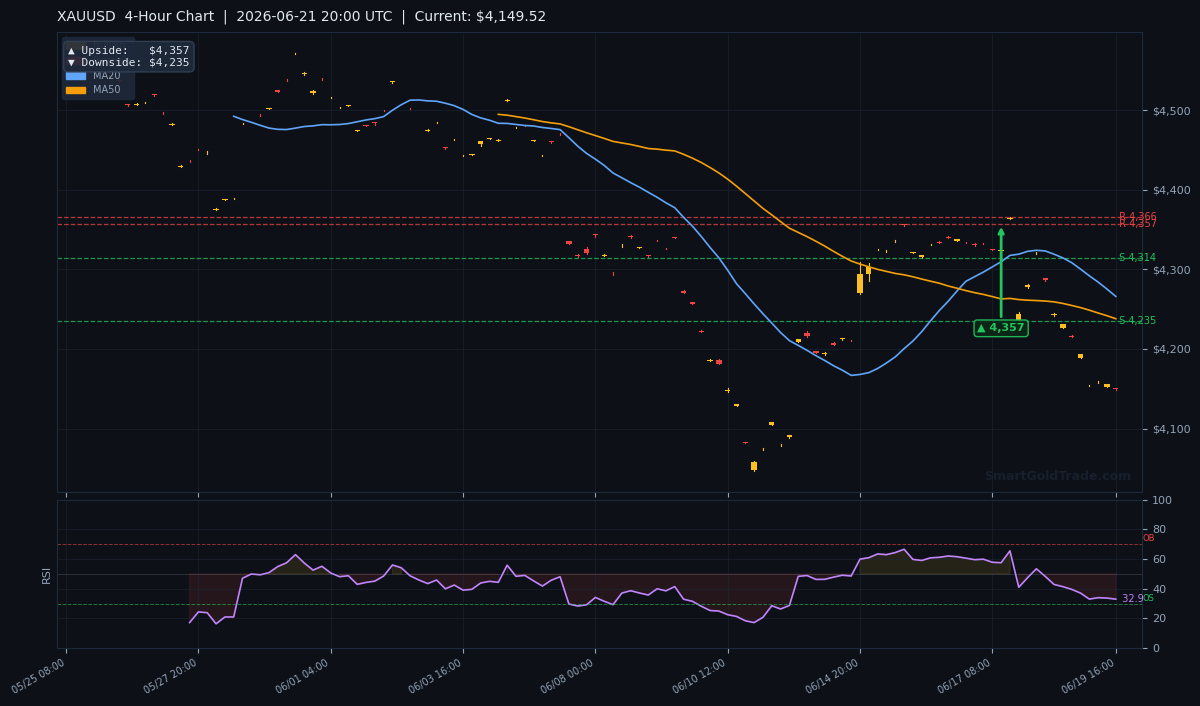
On the 4-hour timeframe, the upside target from the arrow is $4,357, while the downside target is $4,235. The indicator-based support levels are S1 at $4,315.62 and S2 at $4,313.77, but because price trades well below them, these levels now act as overhead resistance. Real support on this chart doesn’t appear until the $4,235 pivot arrow, making it the first meaningful downside objective.
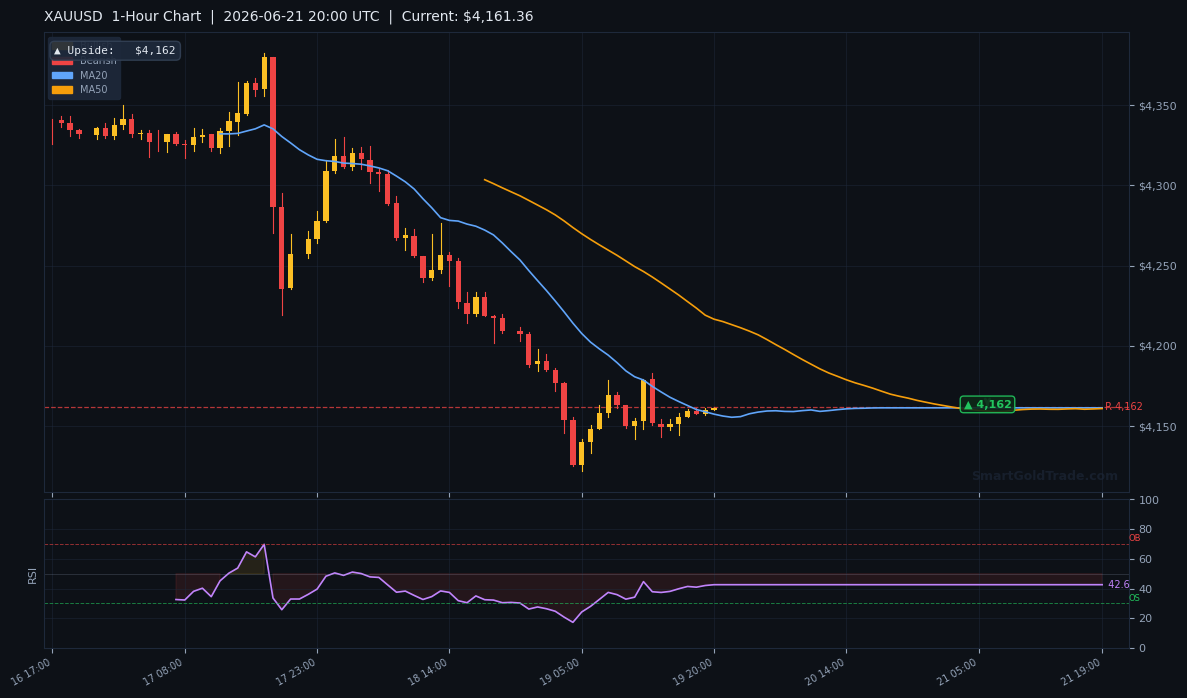
The 1-hour chart gives a much tighter picture. The upside arrow sits at $4,162 — essentially the session’s line in the sand. There is no downside arrow, which aligns with the bearish structure: once $4,162 is rejected, stops get triggered and the next relevant target is the $4,235 4-hour level, keeping the gold price under pressure. The resistance layers R1 at $4,365.61 and R2 at $4,356.90 are too far away to matter in a short trade, so the tactical focus is the $4,162 barrier.
| Timeframe | Resistance | Support | Pivot Target |
|---|---|---|---|
| 1-Hour | $4,162 | N/A | Upside $4,162 |
| 4-Hour | $4,357 | $4,235 | Downside $4,235 |
| Daily | $4,707 | $4,562 | Downside $4,562 |
Fundamental Drivers
The single strongest force pressuring the gold price right now is the repricing of Fed expectations. Last week’s FOMC statement and the updated dot-plot made clear that the committee is still worried about sticky inflation, with the median projection pointing to a terminal rate above 5.25% through year-end. Bond markets quickly adjusted, sending the DXY toward its highest close this month and pushing the gold price below $4,300 in the aftermath.
The U.S.-Iran diplomatic breakthrough initially offered a brief haven bid, but that catalyst has faded quickly. Gold’s usual inverse correlation with real yields has reasserted itself, and with the 10-year TIPS yield staying elevated, any gold price rally is being sold into. Speculative positioning on the Comex also shows that managed money is trimming long exposure, which adds to the downward pressure.
Key Event to Watch
The next major volatility trigger arrives on Friday, June 26, with the release of the Core PCE Price Index for May. This is the Fed’s favorite inflation gauge, and a hotter-than-expected print would reinforce the hawkish messaging, likely pushing gold below $4,150 and accelerating the move toward $4,235. Even a benign print may not rescue the gold price if yields stay elevated, so the directional bias remains bearish going into next week.
Devil's Advocate
The bearish thesis collapses if gold manages a clean 1-hour close above $4,162 and holds that level for more than two candles. A break above that line would trigger stop-losses on short positions and could spark a rapid short-covering rally toward $4,315 — the convergence of S1 and S2. An additional invalidation scenario is a geopolitical shock outside the U.S.-Iran sphere, such as unexpected military tensions in Eastern Europe, which could smother the dollar’s momentum. If the $4,162 resistance is taken out with hourly volume, the trade plan needs to be scrapped immediately.
Trading Strategy for American Session
The setup leans short while gold price remains capped below $4,162. I am looking for an entry zone between $4,159 and $4,162 on a pullback into the hourly resistance. A failed test here — ideally marked by a bearish engulfing candle or a long upper wick on the 15-minute chart — triggers the trade. The stop-loss is placed at $4,175, just above the $4,162 pivot and giving a buffer of $12-$13 to account for intraday noise. Take-profit is set at $4,235, aligning with the 4-hour downside arrow.
This gives a risk of approximately $14 and a reward of roughly $74, a 1:5 risk-reward ratio. Position sizing should be adjusted so that a stop-hit costs no more than 1-2% of account equity. Traders who prefer extra confirmation can watch for a bearish divergence on the 1-hour RSI or a price rejection at the 20-period MA on the 1-hour chart before committing. For those using a halal gold trading platform like SmartGoldTrade, this strategy can be executed as spot with full physical backing and no overnight fees. If you need to acquire physical gold before shorting, you can purchase physical gold from the store. Using a price action trading system for gold can automate candlestick pattern detection and add an extra layer of timing precision to entries.
Key Takeaways
- Gold price is bearish below the $4,162 hourly resistance; every intraday rally stalls there.
- The $4,235 level, marked by the 4-hour pivot arrow, is the primary downside target for the American session.
- A stop-loss at $4,175 keeps risk contained to $14 while opening a $74 reward potential.
- The 4-hour RSI at 33 suggests there is still room to the downside before oversold conditions hit.
- Overhead resistance from the previous support cluster at $4,315 adds to the selling pressure on any bounce.
- Friday’s Core PCE data on June 26 is the next fundamental driver that could push gold below $4,150 toward $4,235.
Conclusion
The gold price continues to struggle under the weight of a hawkish Fed and rising real yields. The technical landscape is dominated by a tight resistance at $4,162, and so long as that level holds, the bearish structure targets $4,235. The American session, with its typical liquidity injections, offers the ideal backdrop for a clean short entry with a crisp stop at $4,175. Patience is the key — wait for the test of $4,162, see a rejection, and then commit with a disciplined risk plan. Anything above $4,175 negates the trade and forces a reassessment.
FAQ
Q: What is the key resistance level for gold price today?
A: The immediate resistance is $4,162, marked by the 1-hour pivot arrow. A break above that would shift focus to $4,315 and could invalidate the bearish bias.
Q: What is the downside target for gold this session?
A: The primary downside target is $4,235, which matches the 4-hour pivot arrow and the next visible support below current levels.
Q: Why is gold falling despite geopolitical uncertainties?
A: The hawkish Fed stance and rising U.S. yields are overpowering safe-haven demand. The dollar’s strength is directly weighing on gold, even as headlines like the U.S.-Iran deal keep volatility elevated.
Trading Gold (XAU/USD) carries significant risk. This analysis is for educational purposes only and does not constitute financial advice. Always trade responsibly and within your risk tolerance.