Gold Price Pops Higher to $4,116.26 – Can the Rally Hold?
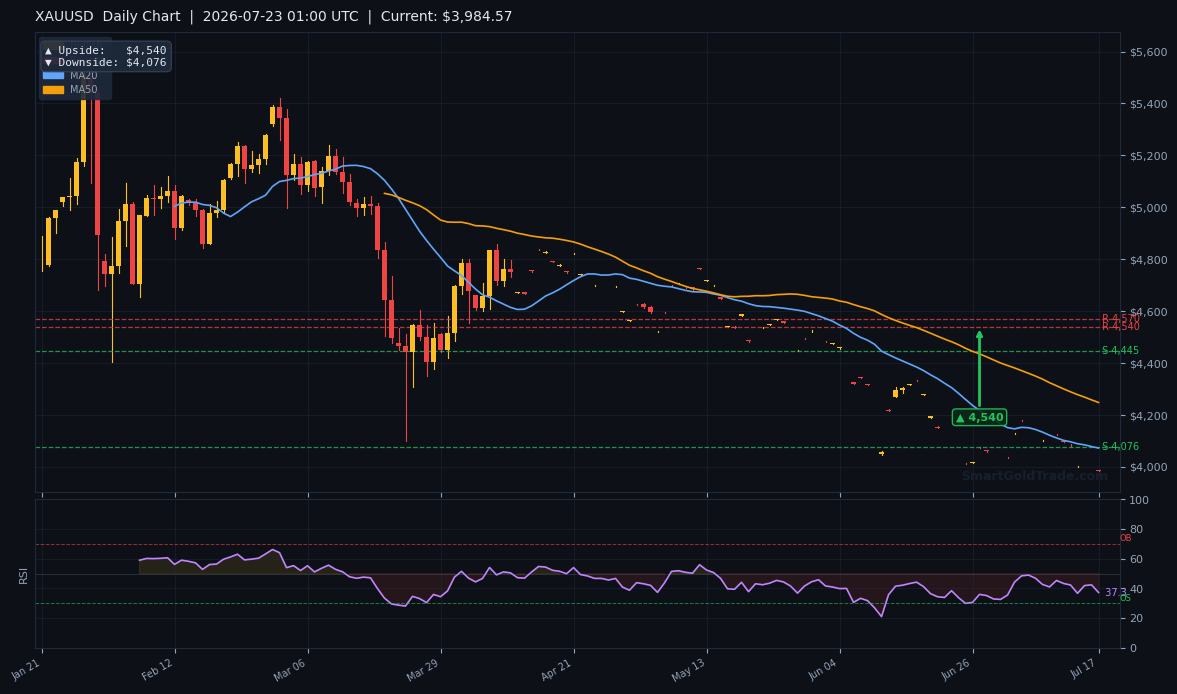
The gold price moved sharply higher in early Asian trading on Wednesday, changing hands at $4,116.26 per troy ounce as of 02:30 UTC on 23 July 2026. A weaker US Dollar – pressured by hawkish European Central Bank rhetoric – gave bullion a fresh tailwind, lifting XAU/USD from a prior session close of $4,013.47. This $102 gap reflects thin liquidity and a surge in real money allocations, but the real test is whether price can sustain above the psychological $4,100 barrier.
Last week’s mixed US housing data did little to shift the Federal Reserve outlook, yet the euro’s push above 1.1405 is telling. Traders are front‑running a potentially hawkish ECB, which is dragging the Dollar Index lower and giving the gold price room to move. With the ECB decision due on Thursday and Asian desks running on skeleton staff, chasing this early bid remains a risky game – so our job is to map the levels that matter and stay patient.
ECB Expectations and Dollar Weakness Fuel the Gold Price Rally
Hawkish whispers from euro‑zone officials have pushed EUR/USD firmly through the 1.1405 resistance, a move that directly pressures the Dollar. When the greenback weakens, dollar‑denominated gold becomes cheaper for buyers holding other currencies, and that exchange‑rate tailwind is lifting the gold price across the board. The Dollar Index has retreated almost 0.5% in overnight trade, a meaningful swing when liquidity is wafer‑thin.
Market pricing now suggests the ECB could signal a faster timetable for rate normalization, something that would catch many offside. If President Lagarde delivers a hawkish surprise on Thursday, we could see another leg lower in the Dollar, opening the door for XAU/USD to test the year‑to‑date highs. Still, expectations are running hot, and any disappointment would quickly unwind the gold price gains we’re watching this morning.
The macroeconomic backdrop remains supportive: real yields are still deeply negative and central bank buying has been relentless. While the Fed stays on hold, any fresh weakness in US data – starting with durable goods orders due later this week – could reignite the bond rally and send the gold price higher. For now, the path of least resistance is cautiously higher, but traders must respect the event risk sitting just 24 hours away.
Technical Levels to Watch for the Gold Price
Zooming in on the 4‑hour chart, the picture is clear: price has broken out of a short‑term consolidation range. The last completed candle closed at $4,013.47, so the overnight gap to $4,116.26 hands a near‑term advantage to buyers. However, gaps in the gold market have a habit of getting filled, especially when they are driven by thin liquidity. The immediate challenge is holding above $4,100.
- Resistance at $4,150 – This level aligns with a previous swing high from two weeks ago and represents the first real test for bulls.
- Resistance at $4,200 – A psychological round number that stalled rallies twice earlier in July. A close above here would flip the medium‑term bias decisively bullish.
- Support at $4,050 – The 50‑period simple moving average on the 4‑hour chart sits here, and a break below would signal fading momentum.
- Support at $4,000 – The major psychological floor that coincides with the gap‑fill target. A breach would negate the current move entirely.
Volume profiles show increased activity between $4,080 and $4,120, suggesting that the bulk of early-hour positions are clustered in this zone. If the gold price can close above $4,120 on the 4‑hour candle, momentum traders will likely pile in, aiming for $4,150. Failure to hold $4,080, however, would invite shorts back into the market.
Momentum oscillators are not yet overbought, giving the rally room to breathe. The relative strength index is hovering around 58, while the MACD lines are crossing above the zero line for the first time in three sessions. These signals align with a controlled, steady grind rather than an explosive blow‑off top, which makes the gold price action a bit easier to trade with defined risk parameters.
How to Trade the Gold Price Halal‑Style – Spot, Not CFDs
Capturing gold price movements is appealing, but conventional leveraged and swap‑based instruments conflict with Islamic finance principles. Most brokers impose overnight interest and require margin accounts that resemble gambling – both strictly prohibited. That’s where halal gold trading comes into play. SmartGoldTrade’s Shariah‑compliant trading platform offers spot gold with immediate physical ownership and zero overnight interest, letting you trade the gold price without compromising your values.
The structure is refreshingly simple: 1 lot equals 1 troy ounce, a fraction of standard broker lots, and every trade is backed by fully allocated, vaulted physical bullion. You’re not speculating on a derivative; you’re buying actual gold. When the gold price climbs, your holdings appreciate in real time, and when you close a position, you can either take the cash or convert it into physical delivery. No riba, no leverage, no hidden charges.
Many traders find that removing the grey areas of interest and opaque margin rules actually sharpens their discipline. You’re forced to size positions according to what you can truly afford, which naturally improves risk management. In a market where the gold price can gap $100 overnight, being fully invested without borrowed money is a genuine edge.
Physical Gold as a Store of Value Amid Price Swings
While short‑term traders can profit from daily volatility, the roller‑coaster nature of the gold price often rewards those who take a longer view. Accumulating physical metal – coins, bars, even jewelry – acts as a steadying force in a diversified portfolio. During geopolitical flare‑ups or currency crises, physical gold behaves differently from paper positions; it’s a tangible asset you can hold outside the banking system.
SmartGoldTrade’s store lets you purchase physical gold in 22K coins from 1‑gram sizes up to 5‑gram pieces, as well as 24‑karat ten‑gram bars and certified jewelry. When the gold price rockets higher, owning physical metal means you capture the full move without slippage, broker risk, or faith‑based compliance worries. And if prices correct sharply, you still own the metal, ready to benefit from the next upswing.
Blending a physical allocation with a spot trading account creates a powerful one‑two punch. You can let the long‑term stash compound in safety while actively trading a portion to generate shorter‑term returns. Both avenues are fully Shariah‑compliant and built around the same core belief: gold is real money, and its price reflects centuries of trust.
Using Trading Signals to Navigate Gold Price Volatility
Gapping markets like today’s can rattle even experienced traders. When the gold price jumps $100 in a few hours, emotions try to take over – and that’s exactly when you need an objective road map. Complementing your own chart work with professional gold trading signals can act as a sanity check, providing pre‑defined entry, stop‑loss, and take‑profit levels right when you need them.
These signals strip away the noise by focusing on high‑probability setups identified by institutional analysts. When the ECB decision drops on Thursday, for instance, a signal service can suggest whether to fade the initial spike or wait for a retest of key support. Pairing real‑time alerts with a halal spot trading account means you can execute without ever worrying about overnight swaps or leverage traps.
What makes signals particularly useful is their role in reducing decision fatigue. Instead of staring at five screens and second‑guessing every tick, you follow a curated plan that has already factored in volume profiles, option expiries, and macro catalysts. In the gold price arena, that kind of clarity is often the difference between a disciplined trade and a fear‑driven mistake.
Risk Management When the Gold Price Gaps
Overnight gaps are a double‑edged sword. Today’s $102 move higher in the gold price offers a beautiful profit for those already long, but chasing it on a thin Asian open is a recipe for whipsaw. Professional traders know that the first 30 minutes after a gap often see a retracement, so placing limit orders below the current price can dramatically improve your entry. Nibbling at support levels rather than buying at the market is a habit worth cultivating.
Stop‑loss placement becomes critical in gapped environments. Using the prior day’s close or a key support like $4,050 gives you a logical invalidation point. Because the gold price can oscillate wildly around news events, widening your stops just enough to avoid premature knock‑outs – while still protecting capital – is a fine art. As a rule of thumb, risking no more than 1‑2% of account equity on any single setup keeps you alive to trade another day.
On Thursday, the ECB meeting could either validate the current rally or trigger a sharp reversal. Having a plan for both scenarios – perhaps buying a dip to $4,080 or shorting a break below $4,000 – transforms uncertainty into an opportunity. In a halal framework, you never have to worry about being charged interest for holding a position through the news, so you can wait for the market to settle before committing capital.
FAQ
What is driving the gold price higher today?
Two main forces are at work: a softer US Dollar after hawkish ECB rhetoric boosted the euro, and thin liquidity that amplifies every tick. The gold price gapped from a $4,013.47 close to $4,116.26 as Asian markets opened, reflecting front‑running of a potentially hawkish ECB decision. Real yields remain deeply negative, adding structural support.
How can I invest in the gold price without paying interest?
Most conventional brokers charge overnight interest (riba) on leveraged positions, which is prohibited in Islamic finance. SmartGoldTrade solves this with a halal spot trading platform where each lot represents physical, fully allocated gold. There’s no leverage, no swaps, and no interest – just pure exposure to the gold price in a Shariah‑compliant manner.
Is it better to trade the gold price or buy physical gold?
It really depends on your goals. Trading lets you capture shorter‑term swings, while physical gold serves as a long‑term store of value and hedge against currency debasement. Many investors combine both: they keep a core position in physical coins and bars, then trade a smaller portion actively using a halal spot account to profit from gold price moves.