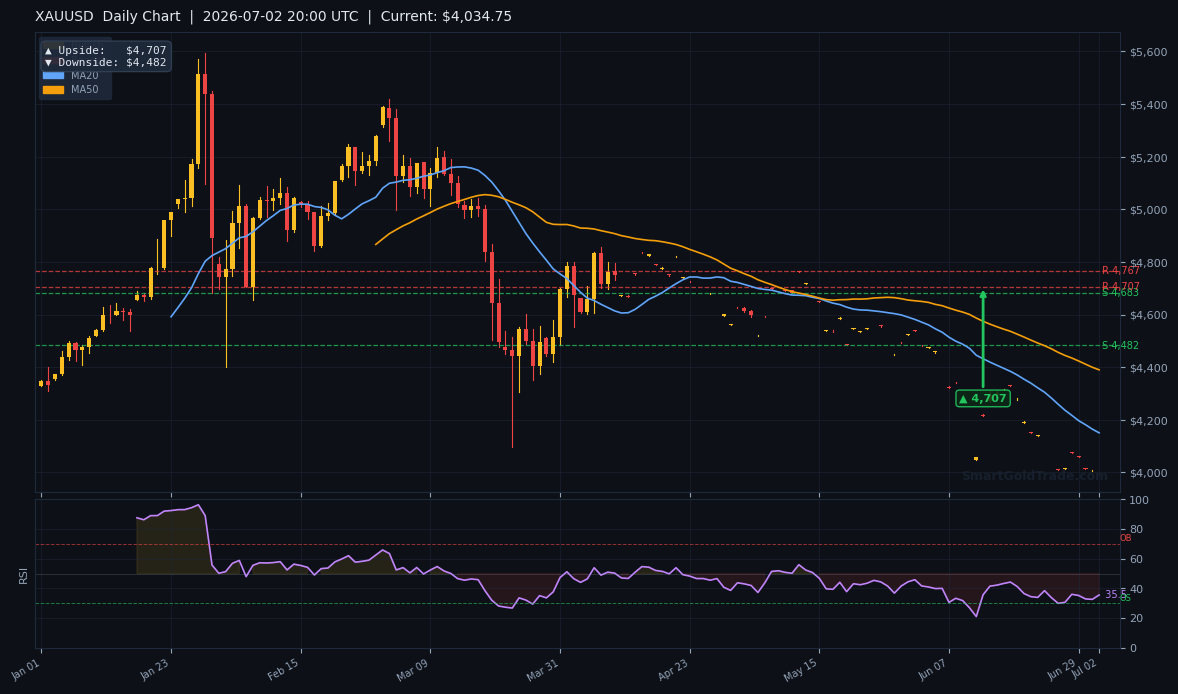
Gold price is holding at $4,068.21 per troy ounce in early London trading on July 2, 2026, after bouncing sharply from an overnight low near $4,050. The yellow metal found strong buying interest at that zone and has since reclaimed the 20-period and 50-period moving averages, shifting the intraday tone back toward a grind higher. Thailand’s May economic data showed broadly stable conditions and still-supportive electronics exports, but offered little direct catalyst for the move. Instead, gold is responding to a steady US dollar and positioning ahead of Friday’s critical nonfarm payrolls report.
Gold Price Live Update – July 2, 2026
During the Asian session, gold price briefly dipped to an overnight low around $4,047–$4,050 before aggressive bids emerged at that support region. The bounce pushed XAU/USD back above the 20-period (currently at $4,052) and 50-period ($4,058) moving averages, suggesting that buyers are defending the short-term uptrend. The intraday bias has turned cautiously positive, though the $4,139 pivot looms as the next major hurdle. A convincing break above $4,139 would target the $4,207 resistance zone, which aligns with the early-June swing high. For now, gold price consolidation just above $4,060 feels healthy, and as New York liquidity builds, a test of $4,070–$4,075 is plausible if the dollar softens further.
What’s Driving the Gold Price Today?
The US dollar has been the dominant short-term driver of the gold price. A relatively dovish tone from Federal Reserve officials recently has kept the greenback on the back foot, even as sticky inflation data lingers. When the dollar weakens, gold becomes cheaper for foreign buyers, often pushing prices higher. Today’s calm in DXY below 98.50 is giving gold room to breathe, but all eyes are on Friday’s nonfarm payrolls (NFP) report. A weak jobs number would cement expectations of a September rate cut, potentially sending the gold price above $4,200.
Geopolitical risks also continue to underpin the safe-haven bid. Uncertainty surrounding global trade policies and tensions in Eastern Europe have kept institutional investors allocating a portion of their portfolios to gold as an insurance policy. Meanwhile, central bank buying—particularly from the People’s Bank of China—has provided a steady floor, even during times of profit-taking. This structural demand makes sudden crashes in the gold price less likely, although intraday swings can be sharp.
On the data front, Thailand’s May economic indicators were a mixed bag. The country’s electronics exports remained resilient, which supports industrial demand for gold in the region, but the numbers didn’t move markets. Instead, traders are laser-focused on US economic data, including today’s ISM Manufacturing PMI and ADP private payrolls, which could set the stage for Friday’s main event. Any sign of cooling in the labor market could light a fire under the gold price.
Also on the radar is the ISM Manufacturing PMI later today. A figure below the 50 threshold could reinforce recession fears, which typically support gold price gains. Conversely, a surprise beat might give the dollar a temporary lift, but any dip in gold is likely to be bought quickly, as the broader macro environment remains gold-friendly.
Beyond the dollar, real yields—the yield on US Treasury bonds adjusted for inflation—are a crucial long-term driver. When real yields fall, the opportunity cost of holding non-yielding gold decreases, making it more attractive. With the Fed hinting at possible rate cuts later this year, real yields have been drifting lower, adding a tailwind to the gold price. This dynamic means that even before a formal rate cut is announced, gold often rallies in anticipation, as investors discount the future policy shift.
The gold price also reacts to inflation expectations. Although official CPI prints have come down from their 2022 peak, many households and businesses still perceive high living costs, driving demand for an inflation hedge. Gold’s historical role as a preserver of purchasing power makes it a logical choice during periods where fiat currency erosion is feared.
Technical Snapshot: Key Support and Resistance Levels
From a chart perspective, the gold price has carved out a series of higher lows since mid-June, with $4,047 acting as the most recent support floor. Below that, the psychological $4,000 mark remains a crucial downside barrier where long-term buyers are likely to step in. The 100-day moving average near $3,980 adds another layer of protection. On the upside, initial resistance stands at $4,085 (today’s Asian high) and the $4,139 pivot. A daily close above $4,139 would signal a resumption of the uptrend and open the door to $4,207, followed by the all-time high near $4,300.
Momentum oscillators on the 4-hour chart are turning higher from neutral territory, while the MACD histogram is printing climbing green bars, hinting at building bullish energy. That said, traders should watch for a potential false breakout around the pivot if the NFP anticipation triggers a risk-off move before the data. Short-term scalpers may find opportunities in the $4,060–$4,080 range, but a break below $4,047 would invalidate the near-term bullish bias.
For those who prefer a systematic approach, a price action trading system for gold can automatically detect candlestick patterns and supply/demand zones, helping you time entries around these critical levels without staring at charts all day.
Zooming out to the daily chart, gold price has been consolidating in a symmetrical triangle pattern since breaking above $4,000 in early June. The apex of this triangle often signals an imminent breakout, and with the trend still bullish, probabilities favor a thrust toward the all-time high of $4,298. Key support remains at the 50-day moving average near $3,980. As long as gold price holds above that trend line, the path of least resistance is to the upside.
Why the Gold Price Matters for Halal Investors
For Muslims seeking Shariah-compliant investments, tracking the gold price is more than just financial curiosity—it’s a practical necessity. Gold meets Islamic finance principles because it is a real asset with intrinsic value, traded on a spot basis without interest (riba). Unlike fiat currencies or conventional derivatives, physical gold ownership is straightforward and permissible. Whether you’re buying a small 22K coin or a 24K bar, the gold price directly determines your entry point.
Halal Ways to Profit from the Gold Price
When the gold price trends higher, there are several Shariah-compliant paths to capture that appreciation without engaging in riba. SmartGoldTrade’s platform is built specifically for Muslim investors looking to align their financial goals with Islamic principles. Here are a few practical ways to get started.
1. Own Physical Gold Directly. Nothing beats the tangibility of holding a gold coin or bar. Our physical gold products include 22K coins from 1g to 5g and 24K bars of 10g, each certified for purity. Because you own the metal outright, your investment directly tracks the spot gold price. It’s a pure store of value that has protected wealth for centuries—no leverage, no interest, no surprises.
2. Join a Musharakah Investment Pool. If you prefer a more passive approach, our Islamic partnership investment pools pool capital from multiple investors to trade physical gold on a spot basis. Each pool is Shariah-audited quarterly, and profits are shared according to pre-agreed ratios. With terms from 6 months to 3 years and historical profit distributions of 4–8%, these pools let you benefit from the gold price without monitoring markets daily.
3. Explore Halal Copy Trading. Copy trading allows you to automatically mirror the strategies of seasoned gold traders. You choose a top performer from a transparent leaderboard (with metrics like ROI, win rate, and drawdown), and the system replicates their gold trades in your account in real time. It’s a hands-free way to ride the gold price, and because it’s spot trading without leverage, it remains fully Shariah-compliant.
4. Consider a Mudarabah Managed Plan. For those with as little as $10, mudarabah plans let professional traders manage your capital under an Islamic profit-sharing model. Plans run for 3 to 12 months with projected returns of 4–7.5%, and SmartGoldTrade trades solely in halal assets. Like musharakah, these plans offer a simplified entry point to the gold price, with risk mitigated by expert oversight.
FAQ
1. What is the current gold price per ounce?
As of July 2, 2026, 06:42 UTC, the live gold price (XAU/USD) is $4,068.21 per troy ounce. This price reflects spot market trading and can fluctuate rapidly throughout the trading day.
2. How does the US nonfarm payrolls report affect the gold price?
Nonfarm payrolls data influences the Federal Reserve’s interest rate decisions. A weaker-than-expected jobs number raises the likelihood of rate cuts, which tends to weaken the US dollar and boost gold price demand as a safe haven. Conversely, a strong report may temporarily pressure gold, but the broader structural demand often limits the downside. Traders closely watch the NFP headline number as well as average hourly earnings and the unemployment rate.
3. Can I invest in gold in a Shariah-compliant way without owning physical bars?
Yes. SmartGoldTrade offers spot gold trading (no leverage, no CFDs), copy trading, mudarabah plans, and musharakah pools—all structured to avoid riba and excessive speculation. You can benefit from gold price movements while remaining fully compliant with Islamic finance rulings and without the need to store physical metal.