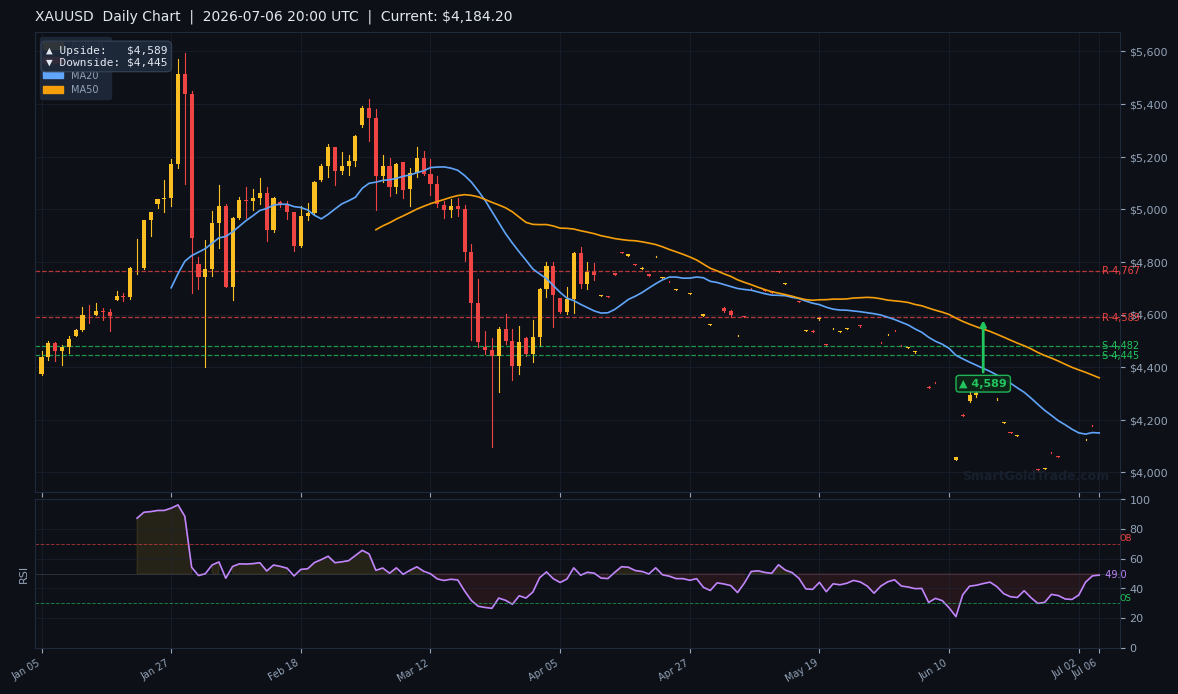
Gold price is hovering at $4,163.05 per troy ounce as the American session gets underway on Monday, July 6, 2026. After last week's sharp bounce that followed the Fed minutes, XAU/USD briefly tested the $4,184.32 resistance but failed to sustain a breakout. Now, with the Independence Day long weekend over, traders are returning to desks, liquidity is creeping back, and the first post-holiday session often delivers choppy, unpredictable moves. The short-term moving averages are still tilting higher, yet the longer-term structure remains decidedly bearish — a tension that demands careful navigation.
The minutes from the June FOMC meeting handed the gold price a lift towards the $4,184 zone, as policymakers acknowledged the uncomfortable mix of sticky inflation and softening growth — historically a supportive cocktail for non-yielding assets. But the rally stopped cold right at the initial resistance ceiling, and momentum has since evaporated. Today's session will be a litmus test: if buyers can't reclaim the $4,175 area with conviction, bears will likely press their advantage and drag the metal towards the $4,150 floor.
Why Gold Price is Hesitating: Fundamental Headwinds
The gold price isn’t trading in a vacuum — it’s wrestling with a trio of macro forces that are keeping the bulls on a short leash. First, the US Dollar Index (DXY) has found its feet again above 100, making gold more expensive for holders of other currencies and capping any impulsive rallies. When the greenback firms up, the yellow metal typically struggles to gain traction, and that’s exactly what we’re seeing.
Second, real yields — the return on Treasury bonds after subtracting inflation — have ticked higher since the Fed minutes. Even a modest rise in the inflation-adjusted 10-year yield makes holding gold more costly because the metal offers no coupon or dividend. Traders learned this lesson during the 2022-2023 rate-hiking cycle, and it remains a reliable pressure valve whenever yields climb.
Third, and perhaps most telling, is the exhaustion in safe-haven flows. Geopolitical hotspots from Eastern Europe to the Middle East are simmering, but none have escalated to the kind of shock that sends investors scurrying into bullion unconditionally. The market has priced in a certain level of uncertainty, and until a fresh catalyst appears — like a surprise CPI print or a dovish signal from Fed Chair — the gold price is stuck in wait-and-see mode.
Technical Analysis: Gold Price Confronts a Fragile Rebound
Zooming out, the daily chart paints a picture of a metal trying to build a base but still trapped inside a descending channel that’s been in place since late May. The recent push above the 20-day and 50-day simple moving averages (SMAs) was encouraging short-term, but the failure to close decisively above the $4,184 resistance exposes a weak-handed rally. Here’s how the technical landscape breaks down right now:
- Resistance levels: Immediate selling pressure sits at $4,184.32, the high from last week’s spike. A clean break above that would target the psychological $4,200 round number, followed by the channel top near $4,240.
- Support levels: First meaningful floor is at $4,150.00, an area that acted as a launchpad twice in the previous fortnight. Below there, the 100-day SMA at $4,110 and the June swing low around $4,075 become critical.
- Momentum signals: The 14-day Relative Strength Index (RSI) has slipped back below 55 after peaking at 62 last week. That’s not oversold territory — it reflects waning bullish momentum rather than a capitulation signal. The MACD histogram is also printing shallower green bars, hinting that trend-following traders are losing conviction.
In practical terms, two scenarios are on the table. If buyers defend the $4,150-$4,155 pocket and recapture $4,175 on rising volume, the narrative shifts back towards a range-bound recovery that could retest $4,184 and eventually $4,200. If, however, sellers push the gold price below $4,150 with a daily close under that support, the floor gives way and a slide towards $4,110 becomes the path of least resistance.
Tools to Navigate Gold Price Volatility
Trading gold around these inflection points can be mentally draining, especially when the chart sends mixed signals as it does now. One way to cut through the noise is to lean on data-driven triggers — for instance, professional gold trading signals that map out entry, stop-loss, and take-profit levels as price approaches key zones. These aren’t a substitute for your own analysis, but they can be a valuable second opinion when you’re staring at a screen and the tension between the shorter-term moving averages and the longer-term downtrend feels overwhelming.
Beyond signals, risk management remains the unsung hero of any gold strategy. Keeping position sizes small during the post-holiday liquidity lull, using alarm-based alerts rather than sitting glued to the chart, and respecting a hard stop below $4,145 — whatever fits your plan — can prevent one sloppy session from denting your capital. Volatility is an opportunity, not a threat, provided you’re prepared for it.
Shariah-Compliant Gold Trading & Investment Opportunities
For Muslim investors, the gold price conversation isn’t just about pips and profits — it’s also about keeping transactions riba-free and backed by real assets. Conventional broker accounts that charge overnight swap fees or offer leveraged CFD positions create a religious compliance headache, which is why purpose-built halal platforms are gaining traction. Interest-free spot gold trading makes it possible to capitalize on the same price moves we’re watching without compromising on Islamic finance principles. Each trade results in physical ownership of the bullion, no leverage is applied, and there are no hidden interest charges — a clean, transparent approach that aligns perfectly with the current technical setup.
Of course, trading is just one side of the coin. Many Shariah-conscious investors prefer to step away from short-term noise altogether and focus on wealth preservation. Holding physical gold remains one of the oldest and most respected hedges in Islamic finance. You can purchase physical gold coins, bars, or jewelry that you actually own and store, giving you exposure to the gold price without any counterparty risk. Whether you stack 1-gram coins or 24-karat bars, tangible gold sits outside the banking system and quietly protects your purchasing power — a quality that never goes out of style, especially when inflation is being described as "stubborn" by the Federal Reserve.
FAQ
What drives the gold price right now in 2026?
The gold price is primarily influenced by US dollar strength, real yields on Treasury bonds, and the pace of Federal Reserve policy decisions. Safe-haven demand from geopolitical tensions and expectations around inflation data also play a significant role. At the moment, the market is digesting the June FOMC minutes and looking ahead to key economic releases that could tilt the balance between further rate cuts and a hold.
Is trading gold halal according to Islamic finance?
Trading gold can be halal if it avoids riba (interest), gharar (excessive uncertainty), and maysir (gambling). Spot gold trading with immediate delivery and no overnight swap fees meets these conditions. SmartGoldTrade’s platform is structured specifically for Shariah compliance, ensuring every trade represents physical ownership without leverage or interest-based costs.
How can I buy physical gold as a long-term investment?
You can buy certified 22K and 24K gold coins and bars from regulated dealers that offer full transparency on weight, purity, and pricing. Look for vaulted storage or home-storage options that suit your security needs. SmartGoldTrade’s physical gold store provides a range of Shariah-compliant products, from small-gram coins to larger bullion bars, all with clear provenance and competitive pricing.