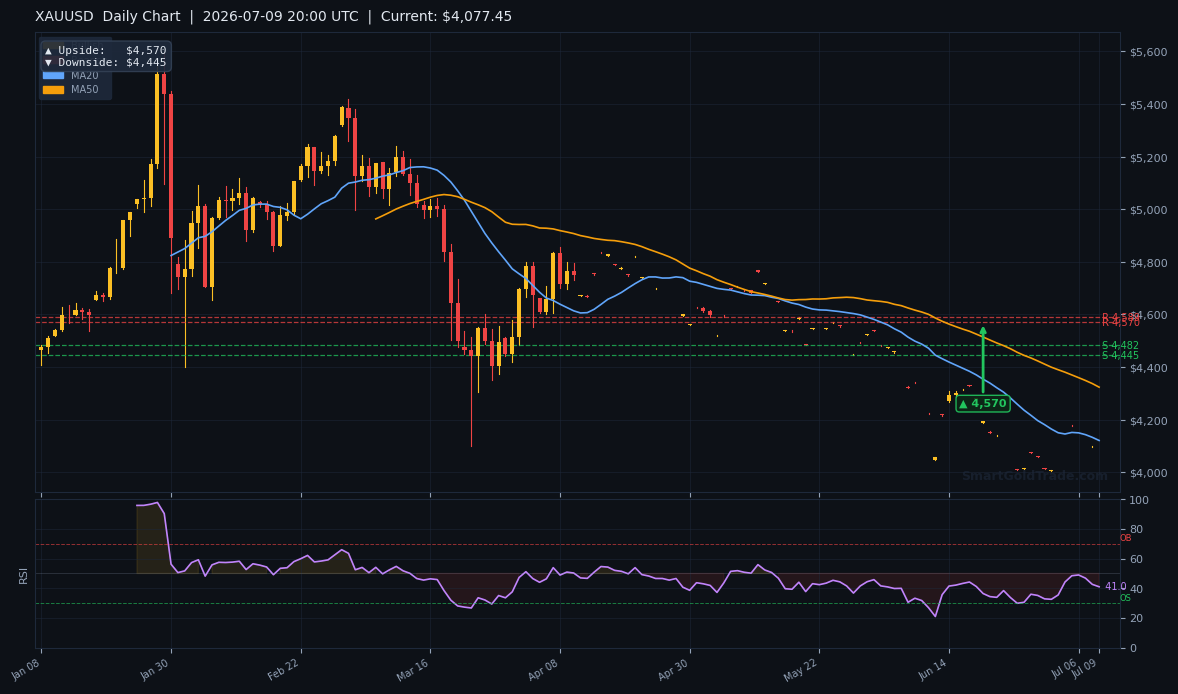
Gold price is consolidating around $4,486.31 per troy ounce as of August 19, 2026, with traders digesting a week packed with macro signals. Last Friday’s disappointing US nonfarm payrolls data, which we detailed in our previous weekly forecast, helped gold push above the $4,150 mark briefly before stalling. Overnight, Brown Brothers Harriman’s Elias Haddad noted an extended broad rally in the South Korean Won, driven by reduced equity rebalancing outflows, adding to the narrative of a softer US Dollar. With the Dollar Index hovering near 101.8 and US 10-year yields stuck below 4.20%, the yellow metal is attempting to build a base. The immediate question is whether gold price can clear the $4,134 intraday ceiling or if sellers will test $4,094 support before the close.
What’s Driving the Gold Price Right Now?
The gold price doesn’t move in a vacuum. It responds to a web of interconnected forces, and right now, several are pulling in the same direction. A softer US Dollar has been the biggest tailwind. When the Dollar Index slips, gold becomes cheaper for buyers holding other currencies, which tends to lift demand. That’s exactly what we’ve seen over the past few sessions.
Yields matter too. With US 10-year Treasury yields stuck below 4.20%, the opportunity cost of holding a non-yielding asset like gold shrinks. Why park money in bonds when inflation-adjusted returns are thin? Investors often rotate into gold during these stretches, and that rotation has kept a floor under prices. It’s not a stampede, but it’s steady.
Geopolitical uncertainty hasn’t gone away either. While no single headline dominates this week, the broader backdrop of trade tensions, central bank buying, and election-year fiscal concerns keeps a bid under the metal. Central banks, particularly in emerging markets, have been net buyers of gold for years now. They’re not chasing momentum; they’re hedging risk. That structural demand is one reason pullbacks in the gold price keep getting bought.
Technical Levels to Watch This Week
Let’s talk numbers, because that’s where the rubber meets the road. The gold price faces immediate resistance near $4,134, a level that has capped intraday rallies twice this week. If buyers can push through that ceiling on strong volume, the next target sits around $4,150, followed by the psychological $4,200 mark. That’s the zone where profit-taking kicked in last time.
On the downside, support at $4,094 is the first line of defense. A daily close below that opens the door to $4,050, where the 50-day moving average comes into play. Keep in mind that moving averages act as dynamic support and resistance. If the gold price dips toward that level and holds, it’s a signal that the broader uptrend remains intact.
Volume has been thinner than usual this week, which is typical for mid-summer trading. Thin volume can exaggerate moves in either direction, so don’t read too much into a single sharp candle. Watch the daily close, not the intraday wick. That’s the signal that matters.
Why the Gold Price Matters for Halal Investors
Gold has always held a special place in Islamic finance. Unlike fiat currencies, it’s a tangible asset with intrinsic value. It can’t be printed into oblivion, and it doesn’t carry interest. That makes it a natural fit for Shariah-compliant portfolios. The gold price isn’t just a number on a screen; it’s a benchmark for wealth preservation that has held up for centuries.
For Muslim investors, the challenge isn’t whether to own gold—it’s how to own it without tripping over riba or excessive uncertainty. Conventional gold CFDs often involve leverage and overnight swap fees, both of which are problematic from a Shariah perspective. That’s why many investors are turning to platforms that offer physical ownership and spot trading instead. You can trade gold the halal way without leverage or interest, which changes the entire risk profile.
There’s also the question of long-term strategy. Some investors prefer to purchase physical gold as a store of value, holding coins or bars they can touch. Others want a more active approach, using spot markets to capitalize on short-term swings in the gold price. Both are valid, and many portfolios combine the two. The key is understanding your own risk tolerance and time horizon.
How to Position for the Next Move
Nobody has a crystal ball, but that doesn’t mean you should fly blind. The current setup suggests the gold price is coiling for a bigger move, and the direction will likely be determined by how the Dollar Index behaves around the 101.8 level. A decisive break below that could send gold toward $4,200 quickly. A bounce in the Dollar, on the other hand, would likely trigger a retest of support.
For traders who want to stay informed without staring at charts all day, professional gold trading signals can help identify entry and exit points based on technical analysis. These aren’t a substitute for your own research, but they can provide a useful second opinion when the market gets noisy.
Risk management matters more than prediction. Set your stop-loss levels before you enter a trade, not after. If you’re wrong, you want to know exactly how much you’re risking. The gold price can move fast when it breaks a key level, and hesitation is expensive.
What SmartGoldTrade Offers
If you’re serious about gold, having the right platform makes a difference. SmartGoldTrade was built specifically for Shariah-compliant gold investing, which means no hidden interest charges, no leverage traps, and full transparency on physical ownership. Whether you’re watching the gold price for a short-term trade or building a long-term position, the tools matter.
What sets this approach apart is the emphasis on real assets. When you trade on SmartGoldTrade, you’re dealing with physical gold, not a paper promise. That distinction matters in Islamic finance, where ownership and clarity are non-negotiable. It also matters practically—if the market gets volatile, you want to know what you actually hold.
FAQ
Why is the gold price rising right now?
The gold price is being supported by a softer US Dollar, low Treasury yields, and ongoing central bank buying. These factors reduce the opportunity cost of holding gold and increase its appeal as a hedge against currency weakness and geopolitical uncertainty.
Is gold trading halal in Islam?
Gold trading is halal when it follows Shariah principles: no riba (interest), no excessive speculation, and immediate or physical settlement. Platforms like SmartGoldTrade offer spot gold trading with physical ownership, which meets these requirements.
What’s a good entry point for the gold price?
That depends on your strategy. Aggressive traders may look for entries near the $4,094 support level, while conservative investors might wait for a confirmed break above $4,134 resistance. Always define your risk before entering any position.